
The rapid growth of artificial intelligence, machine learning, and high-performance computing (HPC) is fundamentally changing the way data centers are designed and operated. At the center of this transformation is the GPU. Once primarily used for graphics processing, modern GPUs have become the computational engines powering AI training, large language models, scientific simulations, and advanced analytics.
As GPU performance continues to improve, power consumption is increasing at an unprecedented rate. This trend is creating new thermal management challenges that traditional cooling technologies are struggling to address. As a result, data center operators, server manufacturers, and infrastructure providers are accelerating the adoption of advanced liquid cooling solutions.
The Rise of High-Power GPUs
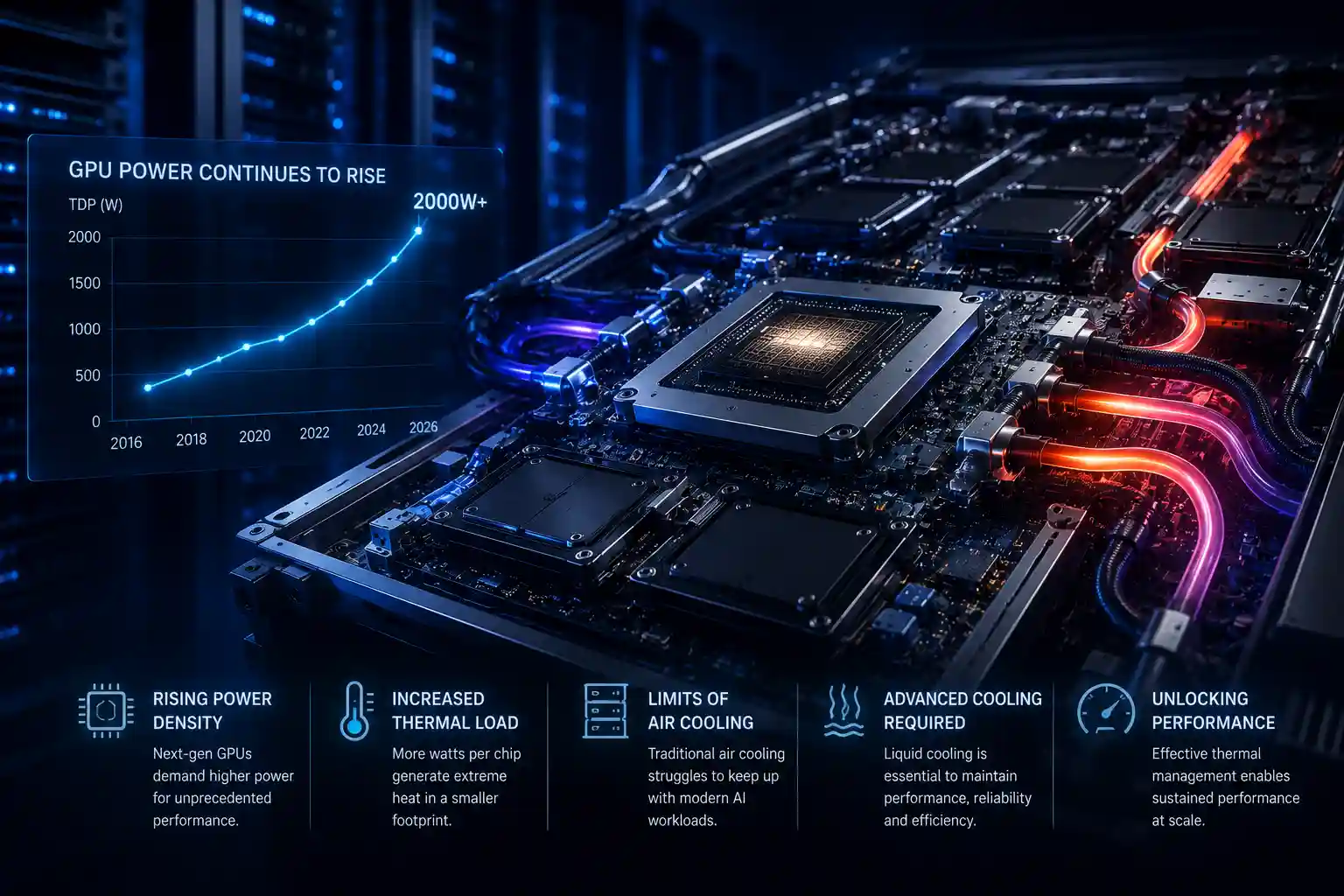
Over the past decade, GPU power requirements have increased dramatically. Modern AI accelerators can consume several hundred watts per device, while the latest generation of AI processors are pushing well beyond 1,000 watts in some configurations.
This increase in power density means more heat is generated within a smaller physical footprint. In large-scale AI clusters containing thousands of GPUs, thermal management becomes one of the most critical factors affecting system performance, reliability, and operational efficiency.
As AI workloads continue to expand, the industry is witnessing a significant shift from traditional air cooling toward more advanced thermal management technologies capable of supporting these extreme heat loads.
Why Heat Matters
Every watt consumed by a processor eventually becomes heat.
If that heat is not removed efficiently, component temperatures rise rapidly, leading to several challenges:
- Thermal throttling
- Reduced computational performance
- Increased energy consumption
- Shortened hardware lifespan
- Higher risk of component failure
For AI applications running continuously at high utilization rates, maintaining stable operating temperatures is essential for maximizing performance and protecting infrastructure investments.
The Limits of Traditional Air Cooling
For decades, air cooling has been the standard approach for data center thermal management. Fans, heat sinks, and airflow systems have successfully cooled servers operating at moderate power levels.
However, as rack power densities continue to increase, air cooling faces several limitations.
First, air has relatively low heat transfer capacity compared to liquid. Removing large amounts of heat requires significant airflow, which increases energy consumption and operational complexity.
Second, higher-density server deployments create localized hotspots that are difficult to manage using conventional airflow techniques.
Third, increased fan speeds generate additional noise and power consumption while offering diminishing returns in cooling performance.
These limitations are driving organizations to explore alternative cooling technologies capable of supporting next-generation AI infrastructure.
The Shift Toward Liquid Cooling
Liquid cooling offers a much more efficient method of removing heat from high-power electronic devices.
Because liquids can absorb and transport heat far more effectively than air, liquid cooling systems can maintain lower component temperatures while supporting significantly higher power densities.
Several liquid cooling technologies are gaining widespread adoption:
Direct-to-Chip Cooling
Cold plates are mounted directly onto CPUs, GPUs, and AI accelerators. Coolant flows through the cold plates and removes heat at the source.
Coolant Distribution Units (CDUs)
CDUs regulate coolant flow, pressure, and temperature throughout the cooling system, ensuring stable operation across large-scale deployments.
Immersion Cooling
Servers are submerged in dielectric fluid that absorbs heat directly from electronic components. This approach can support extremely high thermal loads and is increasingly being evaluated for future AI infrastructure.
Higher Rack Densities and New Design Approaches
The increase in GPU power is also changing how data centers are designed.
Traditional data centers were typically built around lower-density rack configurations. Today, AI deployments often require significantly higher rack power levels, forcing operators to rethink cooling strategies, facility layouts, and infrastructure planning.
Liquid cooling enables:
- Higher rack densities
- Improved space utilization
- Better thermal efficiency
- Reduced cooling energy consumption
- Greater scalability for future workloads
These advantages are making liquid cooling an increasingly attractive option for organizations building AI-ready facilities.
Sustainability and Energy Efficiency
The growth of AI infrastructure is also raising concerns about energy consumption.
Cooling systems account for a substantial portion of total data center power usage. As GPU deployments expand, improving cooling efficiency becomes essential for reducing operational costs and achieving sustainability goals.
Liquid cooling technologies can improve overall cooling effectiveness by reducing fan power requirements and enabling more efficient heat removal. In many cases, they also support heat recovery initiatives that can further improve facility efficiency.
The Future of Thermal Management
As AI models become larger and more computationally demanding, GPU power requirements are expected to continue increasing. Future processors will generate even greater heat loads, placing additional pressure on cooling infrastructure.
Industry experts increasingly view liquid cooling as a key enabler of next-generation AI computing. Advanced cold plates, intelligent CDUs, immersion cooling systems, and hybrid thermal management solutions will play an essential role in supporting future data center growth.
Organizations that invest in scalable cooling architectures today will be better positioned to accommodate the increasing power densities of tomorrow’s AI workloads.
Conclusion
The rapid increase in GPU power is transforming thermal management across the computing industry. As traditional air-cooling technologies approach their practical limits, liquid cooling solutions are becoming essential for maintaining performance, efficiency, and reliability in AI-driven environments.
From cold plates and CDUs to immersion cooling systems, advanced thermal management technologies are enabling the next generation of high-density computing infrastructure. As AI adoption continues to accelerate, effective cooling will remain a critical factor in unlocking future computing performance.