
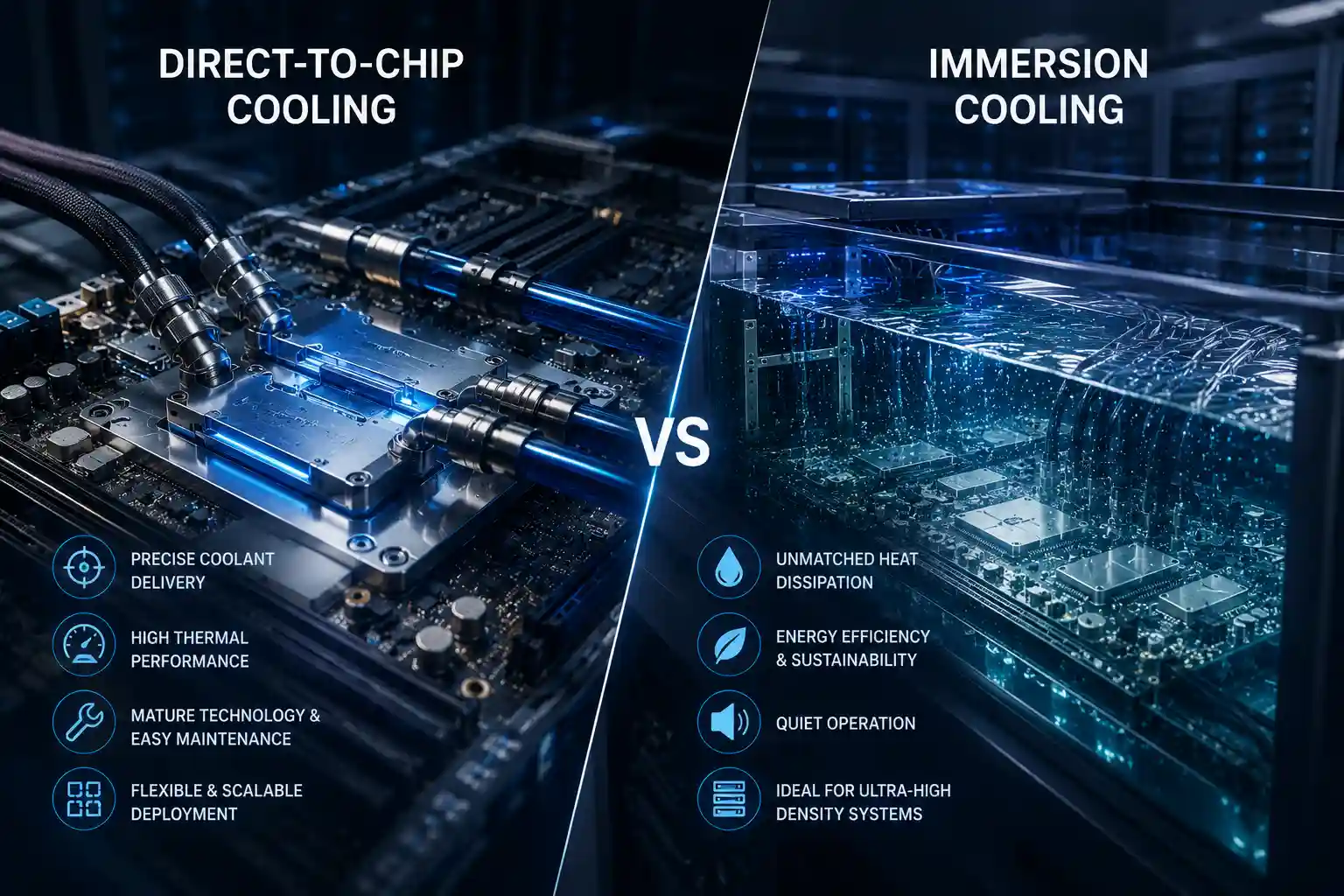
As AI workloads continue to drive unprecedented increases in computing density, data center operators are rapidly adopting liquid cooling technologies to overcome the limitations of traditional air cooling. Among the most widely discussed approaches are Direct-to-Chip Cooling (DTC) and Immersion Cooling.
Both technologies offer significant improvements in thermal performance, energy efficiency, and scalability compared to conventional air cooling. However, they differ substantially in deployment requirements, maintenance procedures, infrastructure compatibility, and long-term operational considerations.
Understanding the strengths and limitations of each approach is essential when selecting the right cooling strategy for your application. Modern AI facilities increasingly evaluate both technologies as rack densities exceed the capabilities of traditional cooling systems.
What Is Direct-to-Chip Cooling?
Direct-to-Chip Cooling uses liquid-cooled cold plates mounted directly onto heat-generating components such as CPUs, GPUs, and AI accelerators. Coolant flows through the cold plates and removes heat directly from the source before transferring it to a Coolant Distribution Unit (CDU) and heat rejection system.
Because cooling occurs at the processor level, DTC delivers highly efficient heat removal while allowing most server hardware to remain largely unchanged.
Key Advantages
- Direct heat removal at the source
- Easier integration into existing data centers
- Compatible with standard server architectures
- Simpler maintenance procedures
- Lower infrastructure modification requirements
Many AI data centers are adopting DTC because it can be deployed within existing rack environments while supporting significantly higher rack densities than air cooling alone.
What Is Immersion Cooling?
Immersion Cooling takes a fundamentally different approach.
Instead of cooling only selected components, entire servers are submerged in a dielectric fluid that absorbs heat directly from all electronic components. The heated fluid is then cooled through a heat exchange process and continuously recirculated.
Immersion systems eliminate most server fans and can achieve exceptional cooling performance in ultra-high-density environments.
Key Advantages
- Extremely high heat removal capability
- Uniform cooling across all components
- Reduced airflow requirements
- Lower cooling-related energy consumption
- Support for very high rack power densities
Immersion cooling is increasingly being considered for specialized AI and HPC deployments where thermal loads are exceptionally high.
Performance Comparison
When comparing pure thermal performance, immersion cooling generally provides the highest heat capture efficiency because the entire server is surrounded by coolant.
Direct-to-Chip cooling removes heat primarily from processors and accelerators, while some residual heat from memory, networking, and power components may still require supplemental air cooling. Industry sources estimate that DTC systems typically remove approximately 70–75% of server heat directly through liquid cooling.
For most enterprise AI deployments, DTC provides sufficient cooling capacity. For extremely high-density applications exceeding conventional liquid cooling capabilities, immersion may offer additional thermal headroom.
Deployment and Infrastructure Requirements
One of the biggest differences between the two technologies is deployment complexity.
Direct-to-Chip Cooling
Direct-to-Chip cooling can often be integrated into existing facilities with relatively modest modifications. Operators can continue using standard rack architectures while adding cold plates, CDUs, and liquid distribution systems.
Immersion Cooling
Immersion cooling typically requires specialized tanks, modified hardware procedures, and redesigned operational workflows. Retrofitting existing facilities may be more challenging due to space, infrastructure, and maintenance considerations.
For organizations seeking a lower-risk migration path toward liquid cooling, DTC is often the preferred starting point.
Maintenance and Serviceability
Maintenance is another important consideration.
Direct-to-Chip systems allow technicians to service servers using procedures similar to traditional IT environments. Coolant lines can be disconnected, and components remain readily accessible.
Immersion cooling requires technicians to remove equipment from dielectric fluid before servicing. This process may involve additional handling procedures, cleaning requirements, and operational adjustments.
Organizations with large operational teams often view DTC as the easier solution from a serviceability perspective.
Energy Efficiency
Both technologies significantly outperform traditional air cooling.
Immersion cooling often achieves exceptionally low cooling overhead because it eliminates much of the airflow infrastructure required in conventional facilities. Some studies indicate substantial reductions in cooling energy consumption compared with traditional approaches.
However, modern Direct-to-Chip systems also deliver major efficiency improvements while maintaining compatibility with existing server ecosystems. Both approaches can support sustainability initiatives and improved Power Usage Effectiveness (PUE).
Which Cooling Technology Is Right for You?
Choose Direct-to-Chip Cooling If:
- You are upgrading an existing data center
- You want to retain standard server hardware
- Maintenance simplicity is important
- You need a proven and widely adopted solution
- Your rack densities are high but within mainstream AI deployment ranges
Choose Immersion Cooling If:
- You are designing a new facility from the ground up
- Maximum cooling density is the highest priority
- Ultra-high-density AI or HPC workloads are planned
- You are willing to adopt specialized infrastructure and maintenance procedures
- Long-term energy optimization is a primary objective
Conclusion
Both Direct-to-Chip Cooling and Immersion Cooling represent the future of data center thermal management. Direct-to-Chip cooling offers a practical, scalable, and easily deployable solution that integrates well with existing infrastructure. Immersion cooling delivers exceptional thermal performance and efficiency but typically requires more significant operational and infrastructure changes.
For most AI data centers today, Direct-to-Chip cooling is emerging as the preferred mainstream solution due to its balance of performance, scalability, and operational simplicity. Immersion cooling remains a compelling option for specialized ultra-high-density deployments where maximum heat removal capability is the primary requirement.