
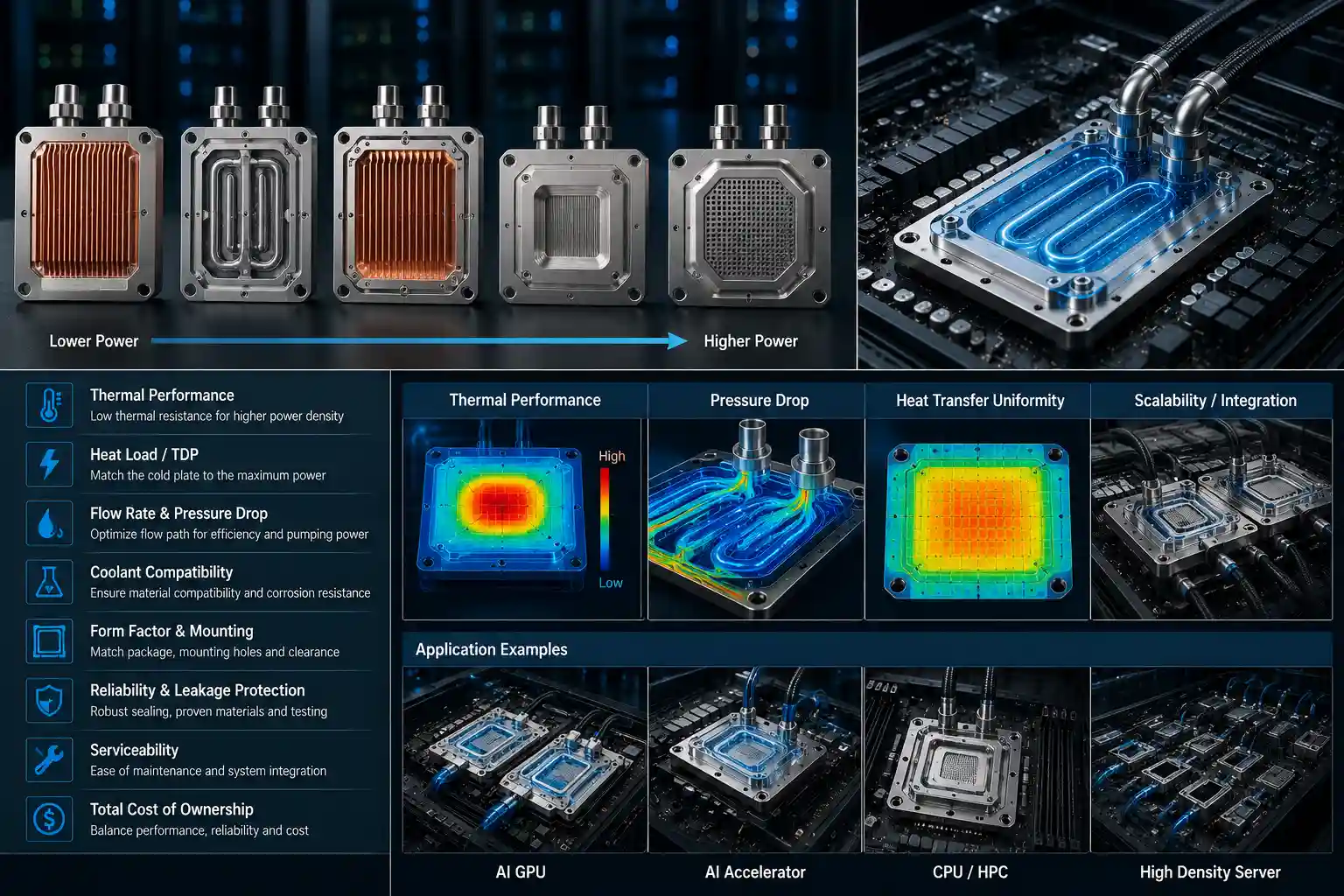
As artificial intelligence continues to drive unprecedented increases in computing power, thermal management has become one of the most critical challenges facing data center operators, server manufacturers, and AI infrastructure providers. Modern GPUs and AI accelerators can generate hundreds or even thousands of watts of heat within a compact footprint, making traditional air-cooling solutions increasingly difficult to sustain.
Liquid cooling, particularly direct-to-chip cooling using cold plates, has emerged as one of the most effective approaches for managing these extreme thermal loads. However, not all cold plates are created equal. Selecting the right cold plate requires careful consideration of thermal performance, pressure drop, material compatibility, scalability, and long-term reliability.
Understand Your Heat Load Requirements
The first step in selecting a cold plate is understanding the thermal characteristics of the target application. AI servers often contain multiple high-power GPUs operating simultaneously, creating localized hotspots and rapidly changing thermal conditions. The cold plate must be capable of removing heat efficiently while maintaining acceptable junction temperatures across all operating conditions.
Higher power densities generally require enhanced internal structures such as microchannels, pin fins, or optimized flow paths that maximize heat transfer between the coolant and the cold plate surface. At the same time, designers must balance cooling performance against hydraulic resistance to avoid excessive pumping requirements.
Evaluate Flow Rate and Pressure Drop
Cooling performance is closely related to coolant flow rate and pressure drop. While increasing flow can improve heat transfer and temperature uniformity, it also increases resistance within the cooling loop and places greater demands on pumps and coolant distribution systems.
An effective cold plate design should provide uniform coolant distribution across the heat source while maintaining reasonable pressure drop levels. Advanced manifold designs and optimized channel geometries can significantly improve flow balance and reduce thermal hotspots.
Choose the Right Material
Material selection plays a major role in cold plate performance and reliability. Copper is widely used in high-performance AI cooling applications due to its excellent thermal conductivity and ability to handle concentrated heat loads. Aluminum offers a lighter and more cost-effective alternative while still providing strong thermal performance for many applications.
Beyond thermal conductivity, engineers must also consider corrosion resistance and compatibility with other components in the cooling loop. Mixing incompatible materials can lead to galvanic corrosion, reducing both system efficiency and service life.
Consider Reliability and Serviceability
AI infrastructure typically operates around the clock, making reliability a top priority. The selected cold plate should undergo rigorous leak testing, flow verification, and long-term reliability validation. Material compatibility, coolant chemistry, sealing methods, and manufacturing quality all influence the overall lifespan of the cooling system.
In addition, maintenance requirements should be evaluated during the design phase. Features such as quick-disconnect fittings, modular assemblies, and accessible service points can simplify deployment and reduce operational downtime.
Optimize for Future Scalability
AI workloads continue to evolve rapidly, and thermal requirements are expected to increase significantly in the coming years. Choosing a cold plate solely for today’s power levels may limit future upgrade opportunities. Scalable designs that accommodate higher heat fluxes, additional GPUs, or expanded liquid cooling infrastructure can help protect long-term investments.
Cold plates designed with modular architectures and standardized interfaces are often easier to integrate into future generations of servers and liquid cooling systems.
Conclusion
Selecting the right cold plate for AI applications requires balancing thermal performance, pressure drop, material selection, reliability, and scalability. As GPU power consumption continues to rise and AI infrastructure becomes increasingly dense, cold plate design will play a critical role in ensuring stable operation, energy efficiency, and long-term system performance.
By carefully evaluating application requirements and partnering with experienced thermal management providers, organizations can deploy liquid cooling solutions that support both current workloads and future AI growth.