
Introduction
When an AI accelerator card pulls past 700W, an EV battery pack starts creeping toward its thermal limit during fast charging, or a 1°C drift in a laser’s resonator throws off beam quality, air cooling simply runs out of runway. Engineering teams researching a fix almost always land on the same term: cold plate. At the same time, whoever’s running procurement or the project is dealing with a different set of questions — who to source from, how fast a sample can turn around, what volume pricing looks like, and whether the supplier can actually be trusted with the tolerances.
This guide covers both sides. We’ll start with a straight definition of what a cold plate is, then walk through how they work, material choices, design types, and applications — the engineering side. From there we’ll shift to selection criteria, cost drivers, and what to ask a manufacturer — the buying side. By the end, you’ll understand both how a cold plate works and what it takes to actually source one.
What Is a Cold Plate?
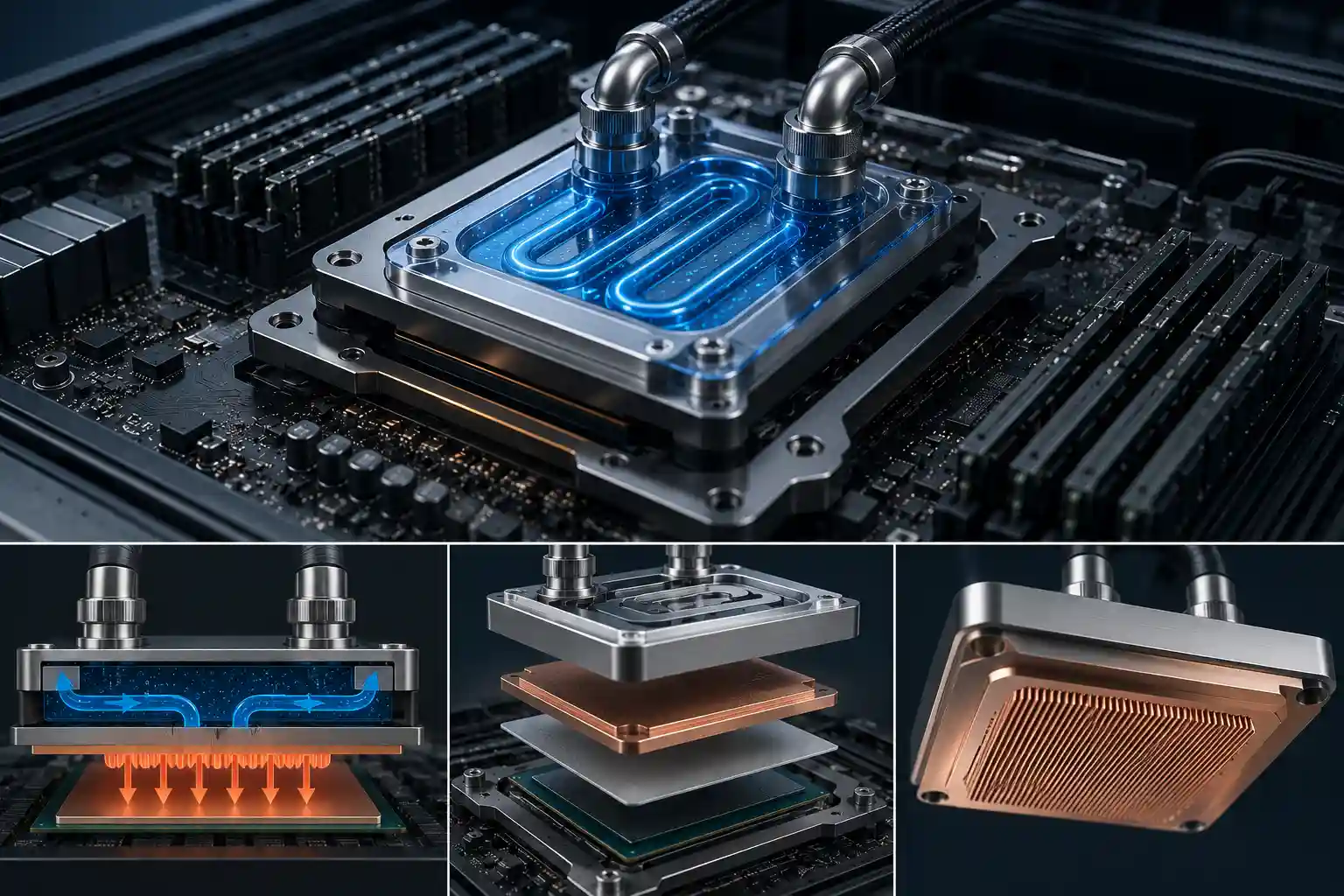
A cold plate is a liquid-cooled heat exchanger that pulls heat away from high-power components — chips, power electronics, battery cells, or laser modules. Coolant flows through internal channels, absorbing heat conducted from the component into the plate. This removes far more heat per volume than air cooling, making cold plates core to data centers, EVs, and laser systems.
How Does a Cold Plate Work?
The physics behind a cold plate comes down to two steps. First, conduction: the heat-generating component — a chip, an IGBT module, a battery cell — sits against a flat, low-thermal-resistance contact surface that pulls heat into the plate body. Second, convection: coolant (typically deionized water or a water-glycol mix, occasionally a dielectric fluid) flows through internal channels machined or formed into the plate, picking up that heat as it passes.
A cold plate never works in isolation. It connects to a manifold at the inlet and outlet, gets driven by a pump, and ultimately dumps its heat at a heat exchanger or CDU (coolant distribution unit) elsewhere in the loop. A well-designed cold plate can still underperform if its pressure drop doesn’t match the pump’s capacity, or if the manifold isn’t balancing flow evenly across multiple plates — which is exactly why cold plates are best designed as part of the full system, not selected in isolation.
Cold Plate Materials: Copper vs. Aluminum
Material choice sets the ceiling on thermal performance, weight, and cost — usually the first trade-off engineers have to make:
- Copper: thermal conductivity around 400 W/(m·K), the top performer for high heat-flux applications like direct-to-chip AI server cooling and laser components — but heavier and more expensive
- Aluminum: thermal conductivity around 200 W/(m·K), a step down from copper but lighter, cheaper, and easier to machine — the common choice for EV battery packs and mid-tier server loads where weight and cost matter more
One thing worth flagging: mixing copper and aluminum in the same loop introduces galvanic corrosion risk, which usually needs to be managed with coatings or by standardizing on one material family — an easy thing to overlook in systems that mix components from multiple vendors.
Types of Cold Plate Designs
The manufacturing method determines a cold plate’s performance ceiling, cost, and best-fit use case. Common types include:
| Type | Characteristics | Typical Use Case |
| Tube-embedded | Metal tubing bent and pressed or bonded into a base plate — the cheapest option with reliable sealing, but higher thermal resistance | Industrial power supplies, motor drives, LED cooling |
| Machined & brazed | CNC-machined channels, vacuum-brazed, fully leak-tested — the most freedom in flow-path geometry | Semiconductor/processor cooling, complex custom flow paths |
| Stamped | All-aluminum stamped construction — one material family, lower galvanic corrosion risk, cost-controlled | Mid-performance, high-volume standardized designs |
| Bonded fin | Fins bonded to the base plate to increase surface area | High-density power electronics |
| Microchannel | Micron-scale flow channels for maximum surface area and turbulence | Chip-level high-heat-flux cooling, AI/HPC servers |
For engineers, the goal isn’t picking the “best” type in the abstract — it’s finding the right balance between target heat load, allowable pressure drop, and cost, which is exactly what the next section walks through.
A few of these are worth a closer look, since they cover the majority of real-world designs. Tube-embedded plates are usually the starting point for cost-sensitive projects: a single continuous tube means there’s effectively nowhere for a leak to start, which is why they show up so often in industrial power supplies and motor drives where downtime from a leak would be far more expensive than the cooling upgrade itself. Machined-and-brazed designs sit at the other end of the spectrum — CNC-cut internal channels give engineers freedom to route flow exactly where the hottest components sit, which matters most on multi-die processor modules or GPU packages where heat isn’t evenly distributed across the surface. Microchannel plates push that same logic further, using channel widths measured in microns to maximize both surface area and turbulence; they’re overkill for a moderate industrial load, but they’re often the only design capable of keeping up with the heat flux coming off a modern AI accelerator.
Key Applications
Cold plates show up well beyond the server room:
- Data centers: direct-to-chip (DTC) liquid cooling is now standard for AI training clusters, where modern GPU racks routinely draw between 85 and 120kW — well past the roughly 25kW ceiling for air cooling. In this setting, cold plates typically mount directly onto CPU and GPU packages, sometimes combined with rear-door heat exchangers or immersion for the rest of the rack. Operators care as much about pressure drop and uniform flow across dozens of plates in a rack as they do about raw thermal performance, since one plate running hot can throttle an entire node.
- EV battery packs: cold plates sit between battery modules to control cell-to-cell temperature variation, support fast charging, and extend cycle life, all while staying light enough not to compromise range or crash safety. Because these plates are structurally integrated into the battery enclosure, they also need to survive vibration and thermal cycling over the vehicle’s lifetime — which pushes most designs toward aluminum, conformal shapes, and welded or bonded construction rather than bolted assemblies.
- Laser and photonics equipment: for high-energy lasers and radar T/R modules, the requirement isn’t just “enough cooling” — it’s flow that’s stable and low-vibration, since even minor disturbances can throw off beam quality and alignment. Temperature stability matters here as much as raw heat removal: a resonator or optical bench that drifts even a degree can shift wavelength or beam pointing enough to fail spec. This is exactly where Apaltek’s liquid cooling solutions focus for precision optical cooling, where flow uniformity and vibration control are engineered in alongside thermal performance.
- Industrial power electronics: SiC/GaN inverters and variable-frequency drives, where microchannel geometry and pressure-drop tolerance become the deciding factors. These applications often run continuously under variable load, so designs need to handle transient thermal spikes without the junction temperature of the power devices exceeding safe limits during peak demand.
How to Choose the Right Cold Plate
Selection builds directly on the material and design-type trade-offs above:
- Define the heat load — peak power at any single point, total heat load, and whether hot spots exist
- Confirm space and weight constraints — especially critical for EV and aerospace applications
- Work out allowable pressure drop and flow rate — matched to what your pump can actually deliver, so you don’t end up with a great cold plate in a system with uneven flow distribution
- Assess volume and customization level — standardized product vs. fully custom flow paths, which directly shapes the cost structure covered next
In practice, these four factors interact more than they compete. A common failure mode looks like this: a team picks aluminum for an EV battery pack to hit a weight target, then discovers during validation that the heat flux at the highest-draw cell exceeds what an aluminum stamped design can handle without an unacceptable temperature gradient across the pack. The fix at that stage — switching to copper or a bonded-fin design — usually costs more in redesign time than it would have if heat load and material had been sized together from the start. The takeaway: heat load should drive material and design-type selection, not the other way around. Space and weight constraints then narrow the field, and volume determines whether a standardized part or a fully custom flow path makes financial sense.
Cold Plate vs. Immersion Cooling
For data center and high-density electronics applications specifically, cold plates aren’t the only liquid cooling option — immersion cooling, where entire boards or components are submerged in a dielectric fluid, is the other major approach. The two aren’t direct substitutes so much as tools for different problems. Cold plates target heat at the source — mounted directly on the specific components generating the most heat, like a CPU or GPU package — which makes them well suited to retrofitting into existing rack designs and to applications where only certain components run hot. Immersion cooling removes heat from every surface in the fluid at once, which can simplify thermal design for extremely dense boards but requires a fundamentally different rack, fluid-handling, and maintenance infrastructure. Most data centers adopting liquid cooling today start with direct-to-chip cold plates because they integrate into existing infrastructure with far less disruption, and some deployments combine both — cold plates on the hottest components, with immersion or rear-door heat exchangers handling the rest.
What Drives the Cost of a Custom Cold Plate
For procurement and project owners, understanding how cost breaks down is more useful than comparing quote totals in isolation. Three factors drive most of the variation:
- Material: copper costs more than aluminum, and also affects machining difficulty and weight
- Manufacturing process: precision and leak-tightness requirements for machined-and-brazed designs push cost up; stamped or tube-embedded processes are more economical
- Volume: prototype-stage unit cost runs well above production-volume pricing, since tooling investment only gets amortized at scale
Lead time tracks the same three factors — a complex machined flow path typically takes longer than a standardized stamped part, which is why nailing down heat load and expected volume early lets a supplier quote more accurately.
Questions to Ask a Cold Plate Manufacturer
As a B2B manufacturer that designs, engineers, and produces custom liquid cooling products, we’d recommend confirming at least the following before committing to a supplier:
- Do they run 100% leak testing (in-line leak detection), or just spot checks that leave room for failures after shipment? A supplier relying on sample-based testing is effectively betting that the units they didn’t test are fine — fine for low-consequence applications, risky for anything mounted near sensitive electronics.
- Is the path from prototype to production clearly defined, with transparent timelines and costs at each stage? Ask specifically what changes between a prototype run and a production run — tooling, inspection criteria, and lead time can shift significantly once volume kicks in.
- Do they hold relevant industry certifications, and do they have track record in your specific application — data center, EV, laser/photonics, or industrial power electronics? A supplier’s general manufacturing capability doesn’t always translate across applications with very different tolerance and reliability requirements.
- Do they support design-for-manufacturing input starting from your thermal parameters, rather than just machining to a fixed drawing? Suppliers who can flag a flow-path issue before cutting metal typically save both time and rework cost compared to ones who simply execute the drawing as-is.
FAQ
What’s the difference between a cold plate and a heat sink? A heat sink dissipates heat into surrounding air, passively or with fan assistance. A cold plate actively removes heat via coolant flowing through internal channels, typically delivering several times the cooling capacity of air — which is why it’s the go-to for high heat-flux applications.
What’s a typical MOQ and lead time for a custom cold plate? It depends heavily on flow-path complexity, manufacturing process, and material — standardized stamped or tube-embedded designs tend to have friendlier MOQs and shorter lead times, while complex machined flow paths take longer. Providing both your heat-load parameters and expected volume upfront helps a supplier quote accurately.
How long does prototyping usually take, and what does it cost? Prototype unit cost typically runs higher than production pricing, since tooling investment hasn’t been amortized yet. Timeline depends on flow-path complexity and material. If you already have rough heat-load and dimensional requirements, reach out to an engineering team directly for a tailored estimate.
Get the Right Cold Plate for Your Project
Once you understand the fundamentals and selection logic, the next step is usually getting a plan built around your actual parameters. Send us your heat load, installation space, and expected volume, and Apaltek’s engineering team will get back to you with an initial design recommendation and quote.
。