
Data Center Liquid Cooling Design Guide: ASHRAE Classes, Facility Water, Sizing and Materials
Every new generation of AI hardware pushes rack power higher, and 50 kW and 100 kW racks are no longer unusual. Most of the attention goes to cold plates and GPUs, but in liquid cooling data center design the hardest things to change later usually aren't the cold plates. They're the decisions made early in […]
How Much Water Does a Liquid-Cooled Data Center Use? Closed-Loop vs. Evaporative Cooling Explained
Headlines about AI data centers drinking as much water as a small town have become routine, and more than a few new campuses have run into local opposition before breaking ground. It’s easy to connect the dots: denser compute means more liquid cooling, so liquid cooling must be what’s driving up water use. That’s only […]
Data Center Liquid Cooling: How It Works, System Components, Costs and When You Need It
Last updated: October 2026 Most data center racks don't draw much power. Uptime Institute's 2026 survey puts the typical rack at about 11 kW, and the average at just 7.8 kW once facilities built for more than 30 kW are set aside. AI racks live in a different world. NVIDIA's GB300 NVL72 reference architecture calls […]
What Is Direct-to-Chip Liquid Cooling? How D2C Systems Work, Pros and Cons
AI silicon keeps getting hotter. Mainstream GPUs and accelerators already draw 700 to 1,000 W apiece, the next generation will draw more, and AI racks are now pushing past 100 kW. Bigger heatsinks and faster fans can't keep up. That's why direct-to-chip liquid cooling has become the default path for AI and HPC data centers. […]
What Is Liquid-Assisted Air Cooling? A Complete Guide for Data Center Operators
Rack power density has outpaced facility upgrades at most data centers over the past two years, and it’s pushing more operators toward liquid-assisted air cooling (LAAC) as a way to close the gap. When a GPU training rack jumps from the low teens into the 40-50kW range or higher, traditional room-level air cooling (CRAC/CRAH) simply […]
What Is Liquid Cooling? How It Works, Types & Benefits
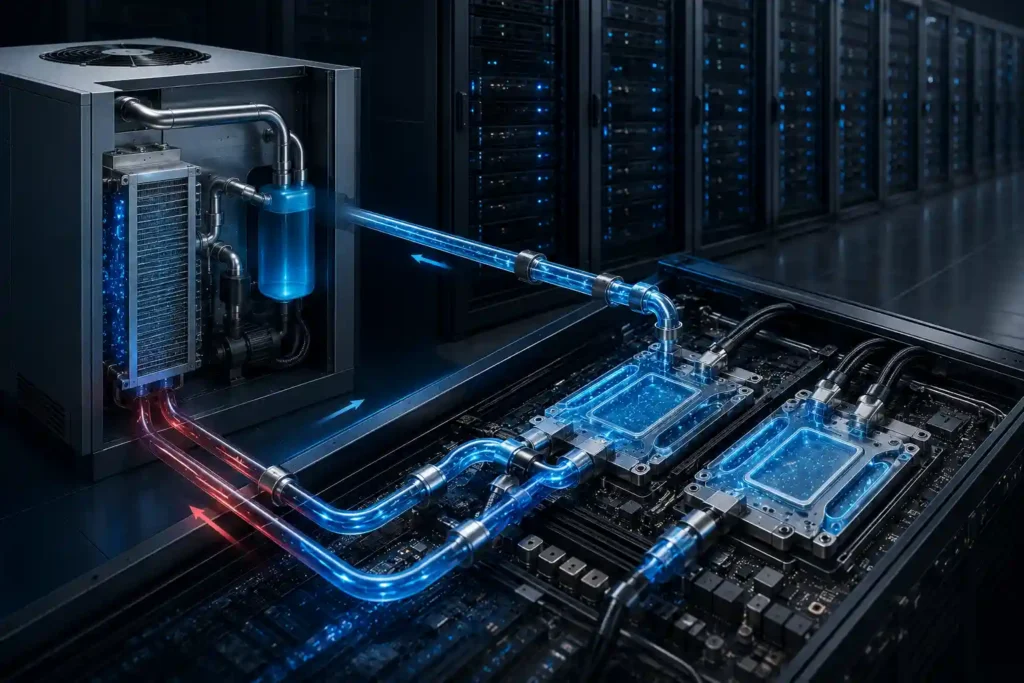
Liquid cooling is a way of removing heat from electronics by circulating a fluid, usually water or a water-glycol coolant, past the hottest components instead of relying on air alone. Because liquid carries far more heat per unit volume than air, it can cool high-power chips in a smaller space and with less fan noise. […]