
AI training and high-performance computing (HPC) are pushing rack power densities into territory that traditional cooling was never built for. Standard racks used to draw a fraction of what they do now, and air cooling handled that without much drama. Today, high-density AI server racks are routinely pushed past the 40kW mark, and in some deployments density climbs toward 100kW or more. No amount of extra fan speed or airflow tuning changes the fact that air simply can’t carry heat away fast enough at that scale. That’s why more and more data centers are turning to liquid cooling.
What Is Liquid Cooling?
Liquid cooling is a thermal management technique that uses a liquid — typically water or a dielectric coolant — instead of air to absorb and carry away heat from servers, GPUs, CPUs, and other IT equipment. Because liquid transfers heat far more efficiently than air, it’s especially well suited to high-density AI and HPC workloads.
How Liquid Cooling Works
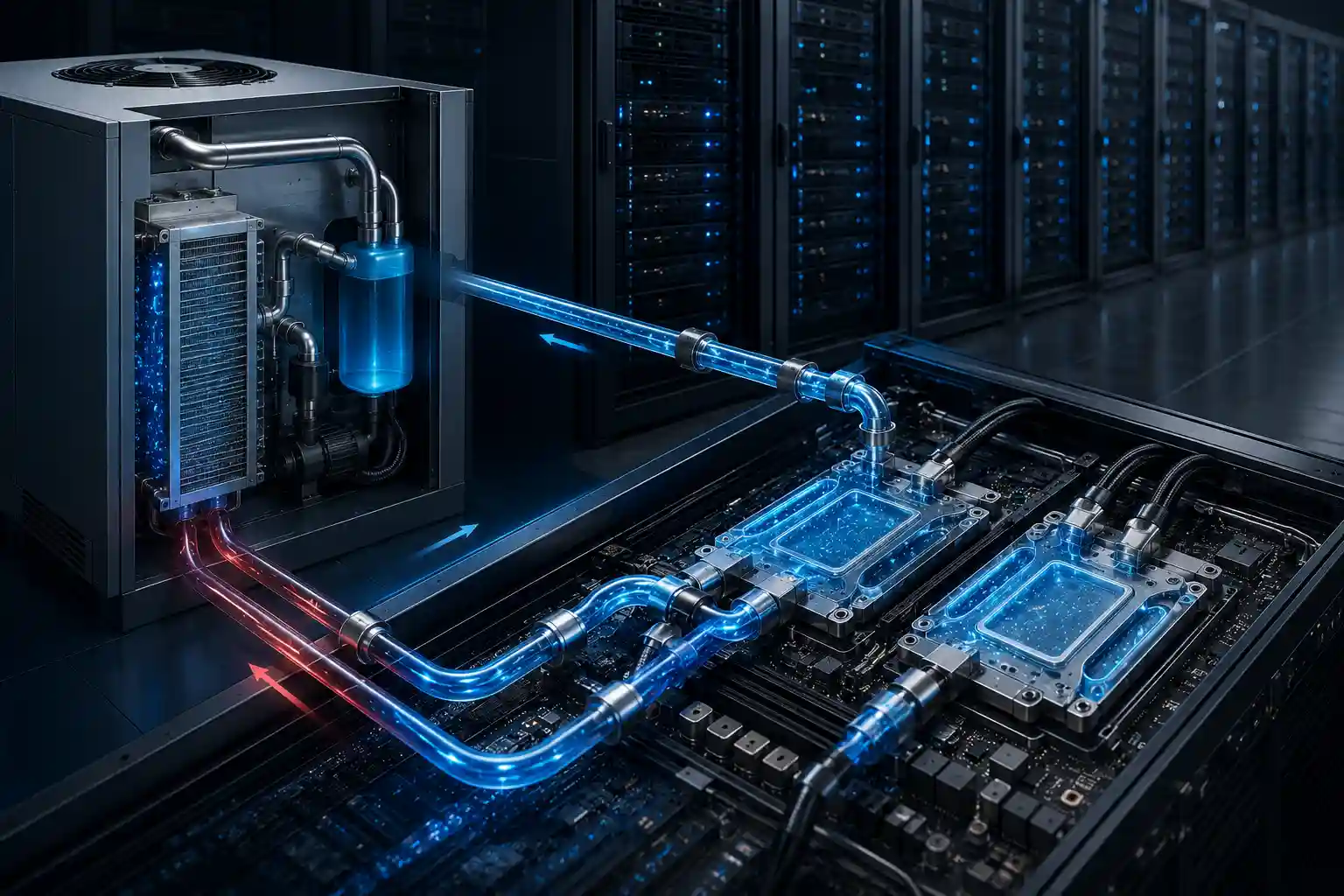
The core idea behind any liquid cooling system is simple: get the coolant as close as possible to the heat source, let it absorb the heat, then move it out of the rack. The warmed coolant is pumped to a heat exchanger or cooling tower, where the heat is finally released. What separates one architecture from another mostly comes down to how close the coolant gets to the chip — the closer it gets, the more precise (and complex) the system becomes. In a cold-plate setup, for example, the coolant never touches the chip directly. Instead, it circulates inside a metal cold plate mounted flush against the chip surface, pulling heat through the plate material and carrying it back through a closed loop to the coolant distribution unit (CDU), which manages flow and temperature before sending the coolant out for heat rejection.
How that final heat gets rejected to the outside world varies by facility. Some sites use dry coolers that reject heat straight to outside air with no water consumption. Others rely on cooling towers or chillers, particularly where climate or density requirements call for it. Because liquid-cooled loops can often run at higher supply temperatures than a chilled-water air-cooling system needs, many facilities get extra hours of “free cooling” — using outside air to cool the loop directly — which is one of the quieter reasons liquid cooling tends to lower both energy use and water use compared to older cooling architectures.
Why Liquid Cooling Is Gaining Ground
The main driver behind this shift is the relentless push for compute density in AI training clusters and HPC applications. Once per-rack power draw exceeds what air cooling can handle, operators are left with two options: scale back rack density (which means more floor space and higher build costs) or move to liquid cooling to keep density high. Cooling capacity aside, the efficiency gains matter just as much. Liquid cooling cuts fan power dramatically, which can bring PUE (power usage effectiveness) down to 1.05-1.15 or even lower — a meaningful number for any operator chasing sustainability targets. Lower noise and vibration are real benefits too, even if they get less attention than the efficiency numbers.
There’s also a sustainability angle beyond raw efficiency. Because liquid coolant can run at higher temperatures than the air stream in a traditional system, the resulting waste heat is often warm enough to be captured and reused — for district heating, industrial processes, or preheating other systems on site — something that’s much harder to do economically with the diffuse, lower-grade heat an air-cooled system rejects.
Main Types of Liquid Cooling
Liquid cooling isn’t one technology — it’s a family of approaches, each suited to a different situation.
Direct-to-Chip / Cold Plate (D2C)
This is the most widely deployed form of liquid cooling in data centers today. A metal cold plate mounts directly onto the CPU, GPU, or other heat-generating component, and coolant flows through a closed loop to absorb and remove heat. D2C targets the biggest heat sources in the rack with precision, requires relatively contained changes to the server itself, and has become the default path for AI and HPC clusters — supporting densities from roughly 40kW up to 200kW per rack depending on the design, at PUE figures that regularly land below 1.15.
Rear-Door Heat Exchanger (RDHx)
An RDHx mounts on the back of the rack and cools exhaust air with a water-cooled coil before it re-enters the room. Its biggest advantage is how little it disrupts existing infrastructure — no changes to the servers themselves are needed, which makes it a strong fit for brownfield projects that need to raise density gradually inside an existing facility. It’s also typically the lowest-cost entry point among liquid cooling options, since it’s essentially a door swap plus a water hookup — a far smaller project than adding a CDU or reworking the floor. The trade-off is a lower density ceiling than cold-plate or immersion systems — generally in the 30-80kW-per-rack range.
Immersion Cooling
Immersion systems submerge the entire server in a bath of dielectric coolant, putting fluid in direct contact with every heat-generating component. Depending on whether the system runs single-phase or two-phase, immersion can support even higher density ranges, and two-phase immersion systems can push PUE as low as 1.01-1.05 — the ceiling for efficiency among current liquid cooling approaches. The catch is higher upfront cost and a strong preference for greenfield builds, since retrofitting immersion into an existing facility means reworking tanks, floor loading, and often the entire mechanical room.
Liquid Cooling vs. Air Cooling
| Factor | Air Cooling | Liquid Cooling |
| Heat transfer medium | Air (fan-driven) | Water or specialized coolant |
| Typical rack density | ~10-40kW/rack | 30-250kW+/rack (depending on type) |
| PUE performance | Typically 1.3-1.6 | 1.01-1.15 (depending on type) |
| Noise and vibration | Higher | Lower |
| Retrofit difficulty | Low (standard architecture) | Varies — moderate for cold plate/RDHx, higher for immersion |
The table makes the trade-off pretty clear: air cooling stays simplest and cheapest to deploy, but it tops out well below what AI-era workloads now demand. Every liquid cooling option buys higher density and better efficiency — the question is which one fits a given facility’s constraints.
How to Choose the Right Liquid Cooling Approach
There’s no one-size-fits-all answer here — the choice comes down to three variables: target power density per rack, whether the project is a new build or a retrofit of an existing facility, and budget and supply-chain timelines. For projects targeting 40-80kW per rack that need to deploy quickly inside an existing room, RDHx or cold-plate systems are usually the more realistic call. Once density targets climb past 100kW per rack on a greenfield build, immersion cooling’s efficiency advantage really starts to pay off. Beyond density alone, coolant compatibility with equipment materials and how the CDU integrates with the facility’s existing water system are engineering details that need to be verified during the selection phase — not discovered during installation.
Budget matters just as much as density. Entry cost scales roughly with how invasive the system is: RDHx tends to be the cheapest way in, since it’s largely a door swap and a water connection. Cold-plate systems cost more once the CDU, distribution piping, and rack-level plumbing are factored in. Immersion sits at the top of the cost curve because of the tanks, fluid volume, and floor infrastructure involved — a cost worth paying only when the density and efficiency gains actually translate into savings elsewhere, such as reduced facility footprint or lower long-term energy spend.
It’s also worth setting expectations early: liquid cooling rarely eliminates air cooling entirely. Many facilities run a hybrid setup, where liquid handles the highest-density racks and air cooling continues to serve auxiliary equipment and lower-density areas — which means the selection question is often “how much liquid cooling” rather than “liquid versus air.”
From Design to Deployment: An Engineering and Manufacturing Perspective
Most content on liquid cooling stops at explaining what it is and why it matters. What actually determines whether a liquid cooling project succeeds, though, comes down to engineering details in the design and manufacturing stage: the fit tolerance between a cold plate and the chip surface, CDU stability across varying water temperatures, and the reliability of piping connection seals. These aren’t things a standardized off-the-shelf product can just handle. As a manufacturer focused on the R&D, design, and volume production of liquid cooling products, APALTEK works from a customer’s actual rack power density, facility water conditions, and certification requirements to deliver custom-designed and validated cold plates, CDUs, manifolds, and complete liquid cooling modules — backed by volume production capability. The goal is turning a liquid cooling plan into a system that actually runs reliably, not just a spec sheet.
That engineering process typically starts with the customer’s thermal load profile and facility constraints — target kW per rack, available water temperature and flow rate, footprint, and whether the deployment is a retrofit or a new build. From there, cold-plate geometry, CDU sizing, and manifold layout get modeled and validated before moving into production, so the design that ships has already been tested against the operating conditions it will actually see in the field, not just idealized lab conditions.
Frequently Asked Questions
Does liquid cooling completely replace air cooling? No. Even in heavily liquid-cooled facilities, most deployments keep some air cooling in place for lower-density components and auxiliary equipment — liquid handles the racks generating the most heat, and air covers the rest.
Is liquid cooling only relevant for hyperscale AI data centers? It’s most common there today, but the same principles apply anywhere heat density outpaces what air can remove economically — HPC clusters, edge sites with limited footprint, and increasingly enterprise data halls running GPU-based workloads.
What’s the difference between direct-to-chip and immersion cooling? Direct-to-chip circulates coolant through a cold plate mounted on top of the chip, so the fluid never touches the component directly. Immersion submerges the entire server in dielectric fluid, putting coolant in contact with every part at once. Immersion generally supports higher density, but direct-to-chip is easier to retrofit into an existing server design.
Do liquid cooling systems risk leaks damaging equipment? Leak risk is a legitimate engineering concern, which is why connector quality, seal design, and leak-detection sensors matter as much as the cooling architecture itself. Well-engineered cold-plate and CDU systems use dripless quick-disconnects and monitored loops specifically to manage this risk.
Can liquid cooling be added to an existing data center, or does it require a new build? It depends on the type. RDHx and, to a lesser extent, direct-to-chip systems can typically be retrofitted into existing rooms with manageable downtime. Immersion cooling is much harder to retrofit — it generally requires the floor loading, containment, and mechanical infrastructure of a greenfield design.
Ready to Move to Liquid Cooling?
If you’re evaluating a move from air to liquid cooling, or need a cold plate or CDU built around a specific power density target, reach out to APALTEK’s engineering team. Share your rack power requirements and facility conditions, and we’ll help you assess the right liquid cooling architecture and put together a custom solution.