
As AI workloads, high-performance computing (HPC), and modern data centers continue to push hardware performance to new levels, effective thermal management has become a critical factor in system reliability and energy efficiency. Choosing the right cooling strategy is no longer simply an operational decision—it directly impacts performance, scalability, sustainability, and total cost of ownership.
Today, the two most common cooling approaches are air cooling and liquid cooling. While both are designed to remove heat from electronic equipment, they differ significantly in how they operate and the level of cooling performance they can deliver.
What Is Air Cooling?
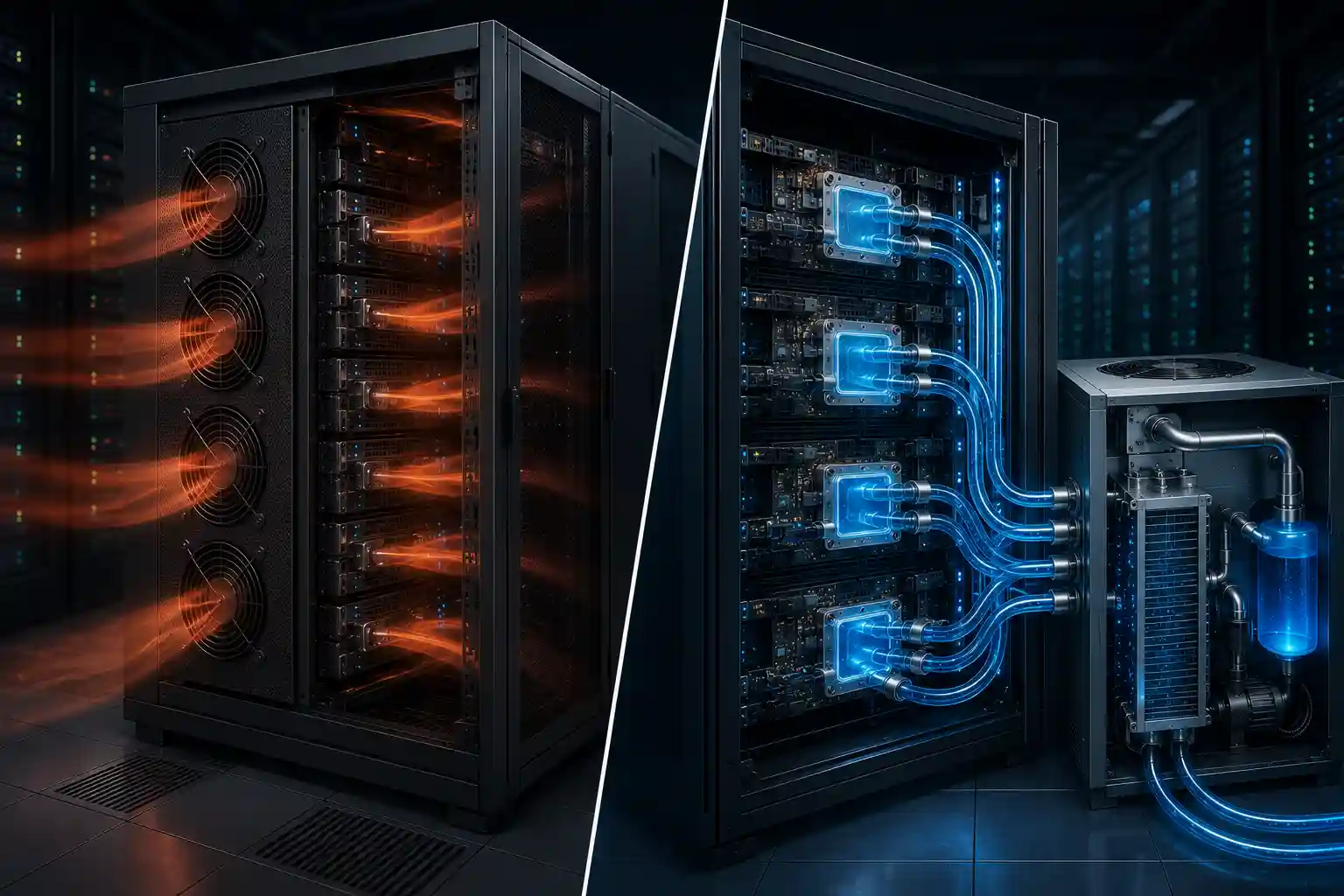
Air cooling is the traditional method used in most servers, networking equipment, and electronic systems. It relies on heat sinks, fans, and airflow management to transfer heat away from components and dissipate it into the surrounding environment. Air cooling removes heat by increasing airflow over hot surfaces and transferring thermal energy to cooler air.
In a typical data center, cold air is delivered through cooling systems and directed toward server racks. As equipment generates heat, fans move the warm air away from components and exhaust it from the rack.
Air cooling has been the industry standard for decades because it is relatively simple, cost-effective, and easy to maintain.
What Is Liquid Cooling?
Liquid cooling uses water or specialized coolants to absorb and transport heat away from electronic components. Instead of relying solely on airflow, liquid cooling transfers heat directly to a circulating liquid, which carries the thermal energy to a heat exchanger or cooling system for rejection.
Modern liquid cooling solutions include:
- Direct-to-Chip Cooling
- Cold Plate Cooling
- Rear Door Heat Exchangers
- Immersion Cooling
- Hybrid Cooling Systems
Because liquids have significantly higher heat transfer capabilities than air, liquid cooling can remove heat more efficiently and support much higher power densities. Water is thousands of times more effective than air at transferring heat.
Performance Comparison
One of the biggest differences between air cooling and liquid cooling is thermal performance.
As processor power consumption continues to increase, air cooling faces physical limitations in its ability to remove heat from densely packed computing systems. High-performance AI servers can generate enormous amounts of heat that traditional airflow-based systems struggle to manage efficiently.
Liquid cooling removes heat much closer to the source, allowing components to operate at lower temperatures and maintain higher performance levels. In high-density computing environments, direct liquid cooling is often the preferred solution.
Energy Efficiency
Cooling infrastructure represents a significant portion of data center energy consumption.
Air-cooled systems require large numbers of fans, air handlers, chillers, and HVAC equipment, all of which consume substantial amounts of power. Liquid cooling reduces the need for high-volume airflow and can significantly lower cooling energy requirements.
Many organizations are adopting liquid cooling to improve Power Usage Effectiveness (PUE) and reduce operating expenses. Studies and industry reports consistently show that liquid cooling can improve energy efficiency compared to traditional air cooling systems.
Scalability and Rack Density
As AI infrastructure continues to evolve, rack power densities are increasing rapidly.
Traditional air cooling works well for lower-density environments but becomes increasingly challenging as rack power requirements grow. Modern AI deployments frequently exceed the cooling capabilities of conventional air-cooled architectures.
Liquid cooling enables significantly higher rack densities by efficiently removing heat directly from processors and accelerators. This allows operators to deploy more computing power within the same physical footprint.
Cost Considerations
Air cooling generally has lower initial deployment costs because it relies on familiar infrastructure and widely available components.
Liquid cooling systems typically require higher upfront investment due to pumps, heat exchangers, coolant distribution units (CDUs), piping, and monitoring systems. However, many organizations find that improved energy efficiency and support for higher-density computing can offset these costs over time.
When evaluating cooling solutions, both capital expenditures (CapEx) and long-term operating expenses (OpEx) should be considered.
Maintenance and Reliability
Air cooling systems are generally easier to deploy and maintain, requiring less specialized expertise. However, they are more susceptible to issues related to dust accumulation, airflow obstruction, and temperature fluctuations.
Liquid cooling systems require more sophisticated monitoring and maintenance procedures but can provide superior temperature stability and thermal control. Modern liquid cooling technologies have become increasingly reliable and serviceable, making adoption easier than in the past.
Which Cooling Method Is Right for Your Application?
The best cooling solution depends on your specific requirements.
Air cooling remains a practical option for traditional enterprise servers, lower-density deployments, and environments where simplicity and lower upfront costs are priorities.
Liquid cooling is often the preferred choice for AI clusters, GPU-intensive workloads, HPC environments, and data centers seeking maximum performance, energy efficiency, and scalability. As computing power continues to grow, liquid cooling is becoming a key enabler of next-generation digital infrastructure.
Conclusion
Both air cooling and liquid cooling play important roles in modern thermal management. Air cooling offers simplicity, familiarity, and lower initial costs, while liquid cooling provides superior thermal performance, energy efficiency, and support for high-density computing.
As AI and high-performance computing continue to drive increasing power densities, liquid cooling technologies are expected to become an increasingly important part of future data center and computing infrastructure strategies.