
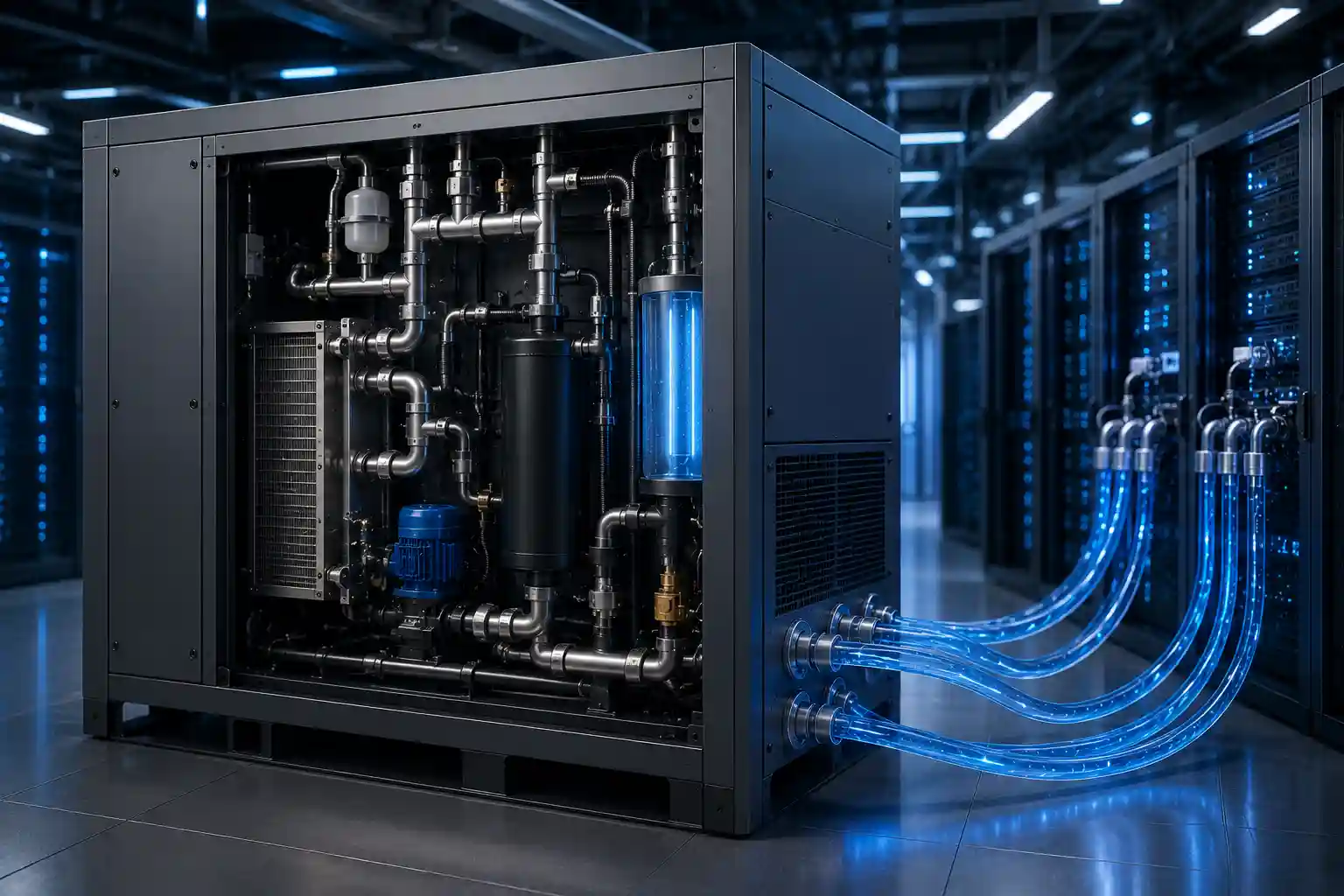
TL;DR: A CDU (Coolant Distribution Unit) is the thermal management device at the heart of a liquid-cooled data center. It sits between the facility’s cooling source and the IT equipment’s liquid loop, using an isolated secondary loop to control coolant temperature, flow, and pressure — removing heat from servers and GPUs without ever letting facility water touch IT hardware. CDUs come in two main form factors: in-rack (built into a single cabinet, up to a few hundred kW) and in-row (standalone units serving multiple racks, up to several MW).
Over the past couple of years, AI training and inference workloads have driven power density through the roof. Rack densities that used to sit comfortably at 5–10 kW now routinely hit 50 kW, 100 kW, or more, and some of the newest rack-scale AI platforms are already pushing well past 120 kW per rack. At that level of heat output, traditional air cooling simply can’t keep up. No matter how much airflow you throw at a data hall, air alone struggles to pull heat away fast enough from densely packed GPUs and accelerators.
That’s why liquid cooling has become the default path forward for AI data centers. And at the center of any liquid cooling system sits one component that determines whether the whole setup runs safely and reliably: the CDU, or Coolant Distribution Unit. If you’re new to liquid cooling, you’ve probably asked yourself a few obvious questions the first time you heard the term — what exactly does a CDU do? How is it different from a standard chiller or cooling source? And why does almost every liquid cooling deployment need one? This guide walks through all of it.
A coolant distribution unit (CDU) is the core thermal management device in a liquid-cooled data center. It sits between the facility’s cooling source, such as a chiller plant, and the IT equipment’s liquid cooling loop, using an isolated secondary loop to precisely control coolant temperature, flow, and pressure. This lets a CDU remove heat from servers and GPUs safely and efficiently, without ever letting facility water come into direct contact with IT hardware.
How Does a CDU Work?
In short: a CDU works by keeping two separate coolant loops isolated from each other and transferring heat between them through a dedicated heat exchanger.
A CDU’s core job is to split the cooling system into two isolated loops:
- Primary loop (facility loop): Connects to the data center’s cooling source — a chiller plant or dry cooler, for example — and supplies relatively unrefined, facility-grade cooling water.
- Secondary loop (IT loop / technology cooling loop): Feeds the cold plates and manifolds inside server racks. This loop requires far tighter water quality and purity standards than the facility side, since even small amounts of particulate or biological growth can clog the microchannels inside a cold plate.
Inside the CDU, a liquid-to-liquid or liquid-to-air heat exchanger handles the heat transfer between the two loops. Coolant in the secondary loop absorbs heat from IT equipment, flows back into the CDU, and transfers that heat to the primary loop’s facility water before cycling back to the racks to keep cooling servers. The key benefit of this design is that IT equipment never touches untreated facility water directly, which eliminates the corrosion, scaling, and biological contamination risks that come with sharing a single loop across the whole building.
Key Components of a CDU
A CDU is built around five core components: pumps, a heat exchanger, controls and sensors, filtration, and a makeup fluid/leak detection module. Together, they keep coolant clean, moving, and within a tight temperature and pressure range at all times.
- Circulation pumps — keep coolant moving through the secondary loop, usually configured with redundancy (N+1) so a single pump failure doesn’t take down cooling to the rack.
- Heat exchangers — liquid-to-liquid or liquid-to-air, and the main factor that caps the CDU’s overall cooling capacity.
- Controls and sensors — monitor flow rate, pressure, temperature, and fluid level in real time; higher-end units also support remote monitoring through DCIM platforms via Modbus or REST APIs, which lets facility teams track every rack’s thermal performance from a single dashboard.
- Filtration — keeps the secondary loop’s coolant clean and prevents particulates from clogging the microchannels in cold plates, which is one of the most common causes of localized hot spots in a liquid-cooled rack.
- Makeup fluid and leak detection — automatically tops off coolant and triggers alerts on sudden pressure drops, acting as the last line of defense for system safety and typically the first thing facility teams check during a maintenance walkthrough.
In-Rack CDU vs. In-Row CDU: Which Type Do You Need?
Short answer: choose an in-rack CDU for single-rack deployments or retrofits, and an in-row CDU when you’re cooling multiple racks and need centralized capacity and redundancy. The industry generally splits CDUs into these two deployment types, and this is usually the first decision point customers get stuck on early in a project.
| In-Rack CDU | In-Row CDU | |
| Form factor | 4U–10U rack-mount unit, installed inside the cabinet | Standalone, floor-mounted cabinet placed between or at the end of a row |
| Typical capacity | ~15 kW–300 kW per unit | ~550 kW up to 2.5 MW or more per unit |
| Racks served | A single rack | Typically 3–10+ racks via a manifold network |
| Floor space impact | None (uses internal rack U-space) | Requires dedicated floor space in the row or at the end of a row |
| Failure domain | Isolated to one rack | Can affect an entire row, so N+1 or 2N redundancy is usually required |
| Best fit | Edge sites, single-rack GPU pods, retrofit projects | Large-scale AI training clusters, hyperscale data centers |
As a simple rule of thumb: single-rack deployments and retrofits generally favor in-rack CDUs, while multi-rack, large-scale rollouts that need centralized management and higher redundancy are usually better served by in-row CDUs. Some operators also mix both — using in-rack units for a handful of high-density pods while relying on in-row capacity for the bulk of the data hall.
Why CDUs Matter for AI Data Centers
CDUs matter because they let data centers cool far higher power densities than air ever could, while improving energy efficiency, scalability, and equipment reliability at the same time. As GPU and AI accelerator power densities keep climbing, air cooling is running up against physical and economic limits on heat dissipation, PUE (power usage effectiveness), and noise control. Liquid cooling — with the CDU as its central hub — delivers value in a few key areas:
- Heat removal capacity: Liquid conducts heat far more efficiently than air, supporting rack densities that go well beyond what air cooling can handle.
- Better energy efficiency: Less reliance on heavy air-handling fans helps bring down overall PUE, since cooling accounts for a large share of a data center’s non-IT power draw.
- Scalability: With modular CDU sizing, data centers can scale cooling capacity in step with compute demand instead of rebuilding cooling infrastructure from scratch every time density requirements go up.
- Equipment reliability and lifespan: Tighter, more consistent temperature control reduces the risk of GPU thermal throttling or heat-related failure, which matters even more when a single accelerator represents a significant capital cost.
- Lower acoustic footprint: Liquid cooling reduces the number of high-speed fans needed to move air through a rack, which can meaningfully cut noise levels in the data hall — a growing consideration as facilities move closer to occupied office space.
How to Choose the Right CDU for Your Project
The right CDU depends mainly on your power density per rack, the number of racks you need to cool, and how much floor space and redundancy your operation can support. When evaluating options, it’s worth working through at least these factors:
- Power density per rack or per row — determines the cooling capacity you actually need, and whether a single in-rack unit is enough or you need the aggregated capacity of an in-row system.
- Number of racks and physical layout — concentrated in one row, or spread across multiple zones? This affects whether centralized in-row cooling or distributed in-rack cooling makes more sense.
- Available floor space — enough room for an in-row unit and its manifold piping, or does the project need to work within existing rack U-space with no extra footprint available?
- Redundancy and maintenance requirements — can the operation tolerate a centralized failure domain, and does the maintenance team have the capability and SLA flexibility for live servicing?
- Future scaling plans — sized for today’s needs only, or built with headroom so the cooling infrastructure doesn’t become the bottleneck on the next hardware refresh?
- Integration requirements — does the CDU need to expose telemetry to an existing DCIM or building management system, and does it need to interface with a specific manifold or cold plate design already in use?
No two projects have the exact same rack layout, power curve, or site conditions, and standardized spec sheets rarely map perfectly onto every scenario. That’s exactly where engineering support and custom solution design come in.
Frequently Asked Questions
What’s the difference between a CDU and a chiller?
A chiller is part of the facility’s primary cooling plant — it produces chilled water for the whole building. A CDU doesn’t generate cooling on its own; it sits downstream of the chiller and manages a separate, isolated loop that delivers that cooling capacity safely and precisely to IT equipment.
Can a CDU work with any type of coolant?
Most CDUs are built for specific coolant types, typically water-based fluids with corrosion inhibitors, though some are designed for dielectric fluids used in immersion cooling. Compatibility depends on the CDU’s wetted materials (copper, stainless steel, or nickel-plated components), so it’s worth confirming fluid compatibility with the manufacturer before finalizing a design.
How often does a CDU need maintenance?
This varies by design and duty cycle, but most CDUs need periodic filter checks, coolant quality testing, and pump inspections, with closer monitoring recommended in the first few months after installation. High-availability deployments typically fold CDU upkeep into a broader thermal management maintenance plan rather than treating it as a one-off task.
Do I need a CDU if I’m only cooling a single rack?
In most direct-to-chip liquid cooling setups, yes. Even a single high-density rack needs a CDU — typically an in-rack model — to isolate its cooling loop from facility water and keep temperature, flow, and pressure within safe limits. Air cooling and liquid cooling aren’t interchangeable once cold plates are part of the rack design.
If you’re planning a liquid-cooled data center and aren’t sure whether an in-rack or in-row CDU is the right fit — or you need custom heat exchange capacity, capacity steps, or interface configurations for a specific power density and rack layout — APALTEK’s engineering team can support your project end to end, from solution design through mass production. Get in touch with our engineering team for a customized CDU quote built around your project’s actual requirements.