
Headlines about AI data centers drinking as much water as a small town have become routine, and more than a few new campuses have run into local opposition before breaking ground. It’s easy to connect the dots: denser compute means more liquid cooling, so liquid cooling must be what’s driving up water use.
That’s only half right. A liquid cooling loop is sealed. Water or a water-glycol coolant circulates between the servers, the cold plates and the CDU, and none of it gets used up. What determines how much water a liquid-cooled data center consumes is the last step: how it rejects heat to the outdoors.
This article answers three questions from an engineering perspective: where the water in a liquid cooling data center actually goes, how much each heat rejection method uses, and how to design a liquid-cooled data center that uses almost none.
Key takeaways
- The liquid cooling loop itself is closed and consumes almost no water.
- Water is consumed only where heat is rejected through evaporation, mainly in cooling towers.
- A cooling tower rejecting 1 MW of heat at full load uses roughly 45,000–56,000 liters of water a day.
- Liquid cooling makes low-water designs possible because it can run on warmer supply water, which lets dry coolers handle more of the year.
- Going waterless usually costs some energy, so the right choice depends on local water stress, the power grid and climate.
How Much Water Does a Liquid-Cooled Data Center Use?
A liquid-cooled data center’s water use depends on how the facility rejects heat, not on liquid cooling itself. The closed cold plate loop needs only an initial fill and occasional top-ups. With dry coolers, cooling water use is close to zero. If cooling towers reject all the heat, expect roughly 2 liters per kWh of heat at full load.
Where Does the Water Go in a Liquid-Cooled Data Center?
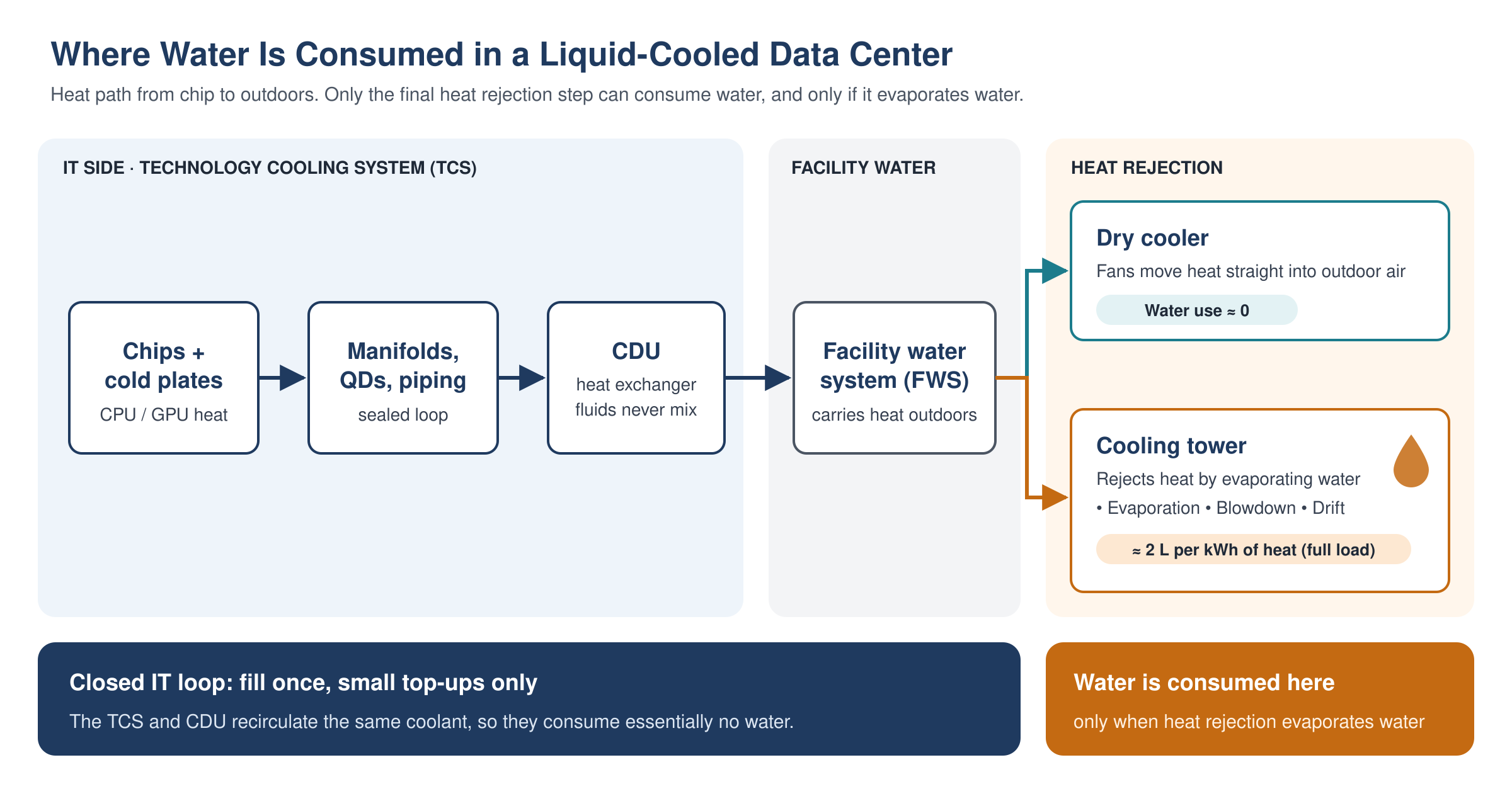
A typical data center liquid cooling system has three parts:
- Technology cooling system (TCS): The closed loop of cold plates, rack manifolds, quick disconnects and secondary piping that carries heat away from the chips.
- Coolant distribution unit (CDU): A plate heat exchanger hands TCS heat to the facility side, and the two fluids never mix. (See how a CDU works.)
- Facility water system (FWS) and heat rejection: Moves the heat to chillers, cooling towers or dry coolers, which release it to the atmosphere.
The coolant in the TCS recirculates within the computing area, so none of it is lost. The CDU only exchanges heat and doesn’t consume water either. Water is consumed only in the third stage, and only when that stage relies on evaporation. It leaves the system three ways:
- Evaporation: A cooling tower removes heat by evaporating a small share of its circulating water. This is where most of the water goes.
- Blowdown: As water evaporates, dissolved minerals concentrate. Some of that water has to be drained and replaced with fresh makeup water to prevent scale and corrosion.
- Drift: Fine droplets carried off in the exhaust air. Modern drift eliminators keep this very low.
That’s the difference between the two approaches in this article’s title. Closed-loop cooling recirculates the same fluid in a sealed circuit, so it doesn’t consume water as it runs. Evaporative cooling removes heat by evaporating water to the atmosphere, so it needs a constant supply of makeup water.
So the real question isn’t whether liquid cooling uses water. It’s how the facility rejects heat.
How Much Water Does Each Heat Rejection Method Use?
The table below compares common heat rejection methods. Water use is shown in relative terms, since actual numbers depend heavily on climate, load and operating strategy.
| Heat rejection method | On-site cooling water use | Energy / PUE impact | Best climate | Typical fit |
|---|---|---|---|---|
| Dry cooler | Near zero | Fan power climbs on hot days; may need chiller trim | Cool to mild | Water-scarce sites; liquid loads that accept warm supply water |
| Adiabatic / hybrid cooler | Low; water sprayed only in hot hours | Between dry coolers and cooling towers | Hot, dry | Projects balancing water savings and peak efficiency |
| Open cooling tower | High (evaporation + blowdown) | Very efficient | Any; water use rises in hot, dry weather | Water-rich sites with high power costs |
| Water-cooled chiller + cooling tower | High | Chiller power, offset by low condensing temperature | Any | Legacy air-cooled halls; low supply temperatures |
| Direct evaporative air cooling (air side) | Depends on operating hours | Very low | Dry | Air-cooled halls and the air-side share of hybrid halls |
Lawrence Berkeley National Laboratory’s 2024 report notes that dry coolers conserve water compared to evaporative cooling towers, and that evaporation in cooling towers is what has raised concerns about data center water use. For scale, U.S. data centers consumed about 17 billion gallons of water directly in 2023, and LBNL projects that direct use could double or even quadruple by 2028, depending in part on which cooling systems new facilities choose.
Adiabatic cooling sits in between. It sprays water onto media upstream of the air coil only when it’s hot outside, so it uses far less water than an open tower while still taking advantage of the wet-bulb temperature. Trane estimates that adiabatic assist can cut overall water use by 70–80% versus traditional open cooling towers.
How Much Water Does a 1 MW Liquid-Cooled Load Use? A Quick Estimate
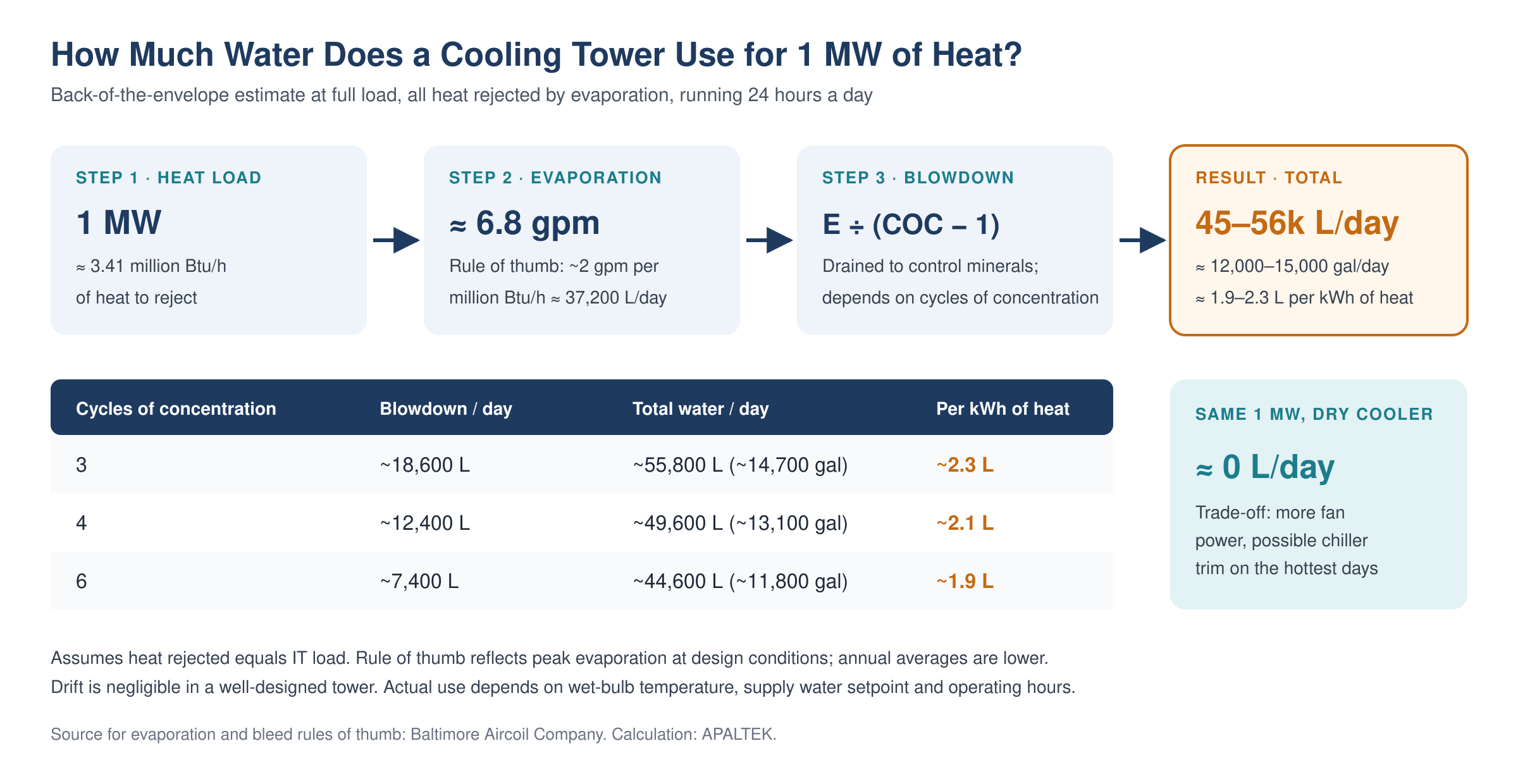
At full load, a cooling tower rejecting 1 MW of heat uses roughly 45,000–56,000 liters (about 12,000–15,000 gallons) of water a day, depending on how many cycles of concentration the tower runs (3 to 6 in this example). Here’s how that estimate works, using standard cooling tower rules of thumb.
Assumptions: A 1 MW IT load, with all heat rejected by cooling towers at full load around the clock. For simplicity, heat rejected equals IT load. In practice, the cooling system’s own power adds a little more.
Step 1: Evaporation. A common cooling tower rule of thumb is about 2 gpm of evaporation per million Btu/h of heat rejection. One megawatt is about 3.41 million Btu/h, so evaporation comes to roughly 6.8 gpm, or about 1,550 liters per hour and 37,200 liters per day.
Step 2: Blowdown. Blowdown equals evaporation divided by (cycles of concentration − 1). How many cycles a tower can run depends on makeup water quality and water treatment:
| Cycles of concentration | Blowdown per day | Total water per day | Per kWh of heat |
|---|---|---|---|
| 3 | ~18,600 L | ~55,800 L (~14,700 gal) | ~2.3 L |
| 4 | ~12,400 L | ~49,600 L (~13,100 gal) | ~2.1 L |
| 6 | ~7,400 L | ~44,600 L (~11,800 gal) | ~1.9 L |
Step 3: Compare with dry coolers. Reject the same 1 MW through dry coolers and on-site cooling water use drops to nearly zero. The trade-off is higher fan power and possible mechanical trim cooling on the hottest days.
Keep three caveats in mind. The rule of thumb reflects peak evaporation at design conditions, so the annual average will be lower. How many hours a year the tower actually evaporates depends on local wet-bulb temperatures and the supply temperature setpoint. Drift and other losses are negligible in a well-designed system. Even so, the math makes the point: a 10 MW liquid-cooled hall rejecting all its heat through evaporation at full load uses close to 500,000 liters a day.
WUE Explained: How Data Centers Measure Water Efficiency
The industry’s standard metric is water usage effectiveness (WUE), introduced by The Green Grid in 2011:
WUE = annual site water use (liters) ÷ annual IT equipment energy (kWh)
It’s expressed in L/kWh, and lower is better. A few details matter when you read WUE figures:
- Site vs. source WUE. Site WUE counts only water used on-site. Source WUE also counts the water consumed to generate the facility’s electricity.
- What’s in the numerator. Operators don’t all count the same water. Microsoft, for example, counts only water used for cooling and humidification, while a broader site total that includes restrooms or landscaping will never reach zero, even with water-free cooling. Check the definition before comparing figures.
- Seasonal swings. Evaporative systems use far more water in summer than in winter, so a single quarter doesn’t represent a full year.
- What WUE leaves out. It uses IT energy as the denominator, doesn’t distinguish potable water from reclaimed water or seawater, and says nothing about local water stress. That’s why researchers have argued that WUE works for internal benchmarking but falls short as a regulatory tool.
For reference, hyperscalers now report low fleet averages. Microsoft reports a global WUE of 0.27 L/kWh and PUE of 1.17 for FY25, and AWS reports a global data center WUE of 0.12 L/kWh for 2025. These are fleet averages; individual sites vary widely with climate.
Why Liquid Cooling Makes Low-Water Designs Possible
Liquid cooling doesn’t save water automatically, but it creates the condition that makes savings possible: warmer supply water.
Air-cooled halls that rely on chilled water typically need it relatively cold to cool the air, which makes chillers and cooling towers hard to avoid in summer. Cold plates sit directly on CPUs and GPUs, so the thermal path is much shorter and the cooling loop can run on much warmer coolant. (See how direct-to-chip liquid cooling works.) Raise the supply temperature and the effects compound:
- Dry coolers can reject heat straight to outdoor air for more hours of the year.
- Fewer hours need evaporative assist or mechanical cooling.
- In many climates, evaporative cooling towers can be eliminated entirely.
Microsoft’s next-generation data center design is a public example. It uses chip-level liquid cooling and, once filled, continually circulates water between servers and chillers without a fresh water supply. Microsoft says the design will avoid more than 125 million liters of water per year per data center. Note that it pairs warmer water temperatures with high-efficiency economizing chillers rather than relying on evaporation. It shows that a closed-loop liquid design can eliminate evaporative cooling, not that every zero-water design looks the same.
Sites with no facility water at all have another option: liquid-assisted air cooling or liquid-to-air CDUs, which reject cold plate heat into the room so the existing air handling system can remove it. Water use then depends on how that room cooling rejects its heat.
The Trade-Off: Waterless Isn’t Free
Eliminating evaporation comes with three costs.
Energy use goes up. Evaporative cooling is popular because it’s the most energy-efficient option. As Trane notes, eliminating water use carries a power penalty: with dry coolers, fan power and chiller lift both climb on hot days. Microsoft acknowledged that replacing evaporative systems with mechanical cooling raises PUE, though warmer operating temperatures offset part of that increase.
Electricity uses water too. Thermal power plants consume large volumes of cooling water. Lawrence Berkeley National Laboratory estimates that U.S. data centers consumed about 211 billion gallons of water indirectly through electricity in 2023, far more than they used on-site. Where the grid relies heavily on thermal power plants, a design that saves water on-site but uses more power won’t necessarily have the smallest total water footprint.
Closed-loop doesn’t mean zero water year-round. One published study points to a tech company’s campus under construction that uses a closed-loop liquid cooling system recycling the same water, yet still secured 8 million gallons per day of water capacity for facility-level evaporative cooling during peak heat. The IT loop is closed, but the facility side may still depend on evaporation on the hottest days.
Weigh three factors when choosing an approach: local water stress, the grid’s generation mix and climate, especially summer dry-bulb temperatures. In water-scarce regions with low-water power such as wind and solar, dry coolers usually make sense. Where water is plentiful and power is expensive, evaporative cooling can stay, with higher cycles of concentration and reclaimed water to reduce fresh water use.
Designing a Sustainable, Low-Water Liquid-Cooled Data Center
These are the principles that matter most at the design stage:
- Work backward from the warmest supply temperature the chips can accept. Start with chip junction temperature limits and cold plate thermal resistance, calculate the maximum TCS supply temperature, then set facility water temperatures. Each degree of added supply temperature generally adds hours that dry coolers can run on their own.
- Tighten the CDU approach temperature. The smaller the temperature difference across the CDU heat exchanger, the warmer the facility water can be, and the more hours dry coolers can cover.
- Size dry coolers for local extreme dry-bulb temperatures, with margin. Designing to annual averages forces evaporative or mechanical cooling on the hottest days.
- Use adiabatic cooling for peak shaving. Spray water only during extreme heat, so annual water use is concentrated in a small number of hours.
- Plan for heat reuse. Warm liquid cooling return water is well suited to building heat or district heating networks, and every kilowatt-hour of heat reused is one less that has to be rejected to the atmosphere.
- Manage the TCS itself. Leak detection, pressure monitoring and coolant quality management keep top-ups to a minimum. (For coolant selection and water quality, see our direct-to-chip coolant guide.)
- If you keep cooling towers, run them well. Better water treatment raises cycles of concentration, and reclaimed or non-potable water can replace fresh makeup water.
ASHRAE liquid cooling water classes and detailed facility design will be covered in our upcoming liquid cooling data center design guide.
Benefits of Waterless Liquid Cooling for Data Centers
“Waterless liquid cooling” is used two ways in the industry:
- No water consumed on the facility side. The IT loop still uses water-based coolant, but heat rejection doesn’t rely on evaporation. That’s the meaning used in this article.
- No water in the IT loop. A dielectric fluid replaces water, as in some two-phase direct-to-chip systems. (See two-phase cold plates and our roundup of data center liquid cooling companies.)
In the first sense, waterless liquid cooling offers several benefits:
- More siting flexibility. Projects are less constrained by water permits and utility capacity and can more easily move into water-stressed regions.
- Easier community approval. Water use has become a flashpoint in many data center approvals.
- No cooling tower water treatment. There’s no ongoing chemical dosing or blowdown management, and one public health risk disappears: cooling towers are a common source of Legionnaires’ disease outbreaks.
- More predictable operating costs. Rising water rates and usage restrictions matter less.
As the previous section showed, these benefits still have to be weighed against higher energy use.
What This Means for Cold Plate and CDU Selection
Whether a facility can go low-water or waterless depends on climate and the facility plant, but it’s also shaped by the IT-side hardware.
Cold plate thermal resistance sets the ceiling on supply temperature. Chip junction temperatures have hard limits. The lower the cold plate’s thermal resistance, the warmer the coolant can be at the same chip power. A low-resistance cold plate effectively buys temperature margin for the whole facility, and that margin turns into more dry cooling hours and less evaporated water.
CDU heat exchange capacity sets how warm the facility water can be. An undersized heat exchanger or a wide approach temperature can use up the margin the cold plates gained.
As a liquid cooling manufacturer, APALTEK designs and builds both cold plates and CDUs in its own factory:
- Custom cold plates: Channel designs based on chip package, power distribution and target supply temperature for server CPUs, GPUs and more. Browse our cold plate products.
- CDUs: The In-Rack CDU (150 kW) and In-Row CDU (2.5 MW) cover different deployment scales.
- Testing and validation: Leak and pressure testing verify sealing performance and structural integrity, and the In-Rack CDU adds internal and external leak detection to minimize top-ups and leak risk in the TCS.
- One factory, cold plate to CDU: Because both ends of the loop are engineered under one roof, thermal resistance, flow and pressure drop targets can be matched to the CDU early in the project.
Learn more about our AI data center liquid cooling solutions.
FAQ
Does closed-loop liquid cooling use water?
Almost none. The IT-side loop of a closed-loop system doesn’t consume water as it runs. Coolant circulates between the cold plates, manifolds and CDU, is filled once during commissioning, and only needs small top-ups after maintenance or minor leaks. Whether the data center as a whole consumes water depends on whether the facility rejects heat through evaporation.
Do liquid-cooled data centers use more water than air-cooled ones?
Not necessarily. If both reject heat through cooling towers, the same amount of heat uses a roughly similar amount of water. Liquid cooling’s advantage is that it can run on warmer supply water, which reduces or eliminates evaporative cooling. Whether a liquid-cooled facility uses a lot of water comes down to whether it’s paired with cooling towers or dry coolers.
How much water does the closed TCS loop hold, and how much does it lose?
TCS volume depends on piping length, rack count and the CDU reservoir. It’s a one-time fill and small compared with a cooling tower’s daily evaporation. In normal operation, losses come only from maintenance disconnects and minor leaks, and top-ups use treated coolant rather than a continuous municipal water feed. For when to replace coolant, see our coolant guide.
What is a good WUE for a data center?
There’s no single benchmark, because WUE varies with climate and with what each operator counts. For reference, hyperscalers report fleet-average WUE between about 0.1 and 0.3 L/kWh. When comparing WUE, look at climate, site vs. source accounting and PUE together.
Does immersion cooling use water?
Immersion tanks use dielectric fluid instead of water, but the heat still passes through a heat exchanger to the facility side. Whether the facility consumes water depends on its heat rejection method. For a full comparison, see direct-to-chip cooling vs. immersion cooling.
Start with Supply Water Temperature, Then Choose the Hardware
Liquid cooling doesn’t use much water; evaporative heat rejection does. To build a data center with low WUE, or one that uses no water for cooling at all, start with how warm the supply water can be. Cold plate thermal resistance sets how warm the TCS coolant can run, the CDU sets how warm the facility water can be, and only then do you choose between dry coolers, adiabatic coolers and cooling towers.
Planning a liquid cooling project? Send APALTEK’s engineering team your rack power, target supply water temperature, local climate and any water restrictions. We’ll assess whether your cold plates and CDU configuration can support a dry cooler or low-water design and recommend cold plate and CDU options to match.