
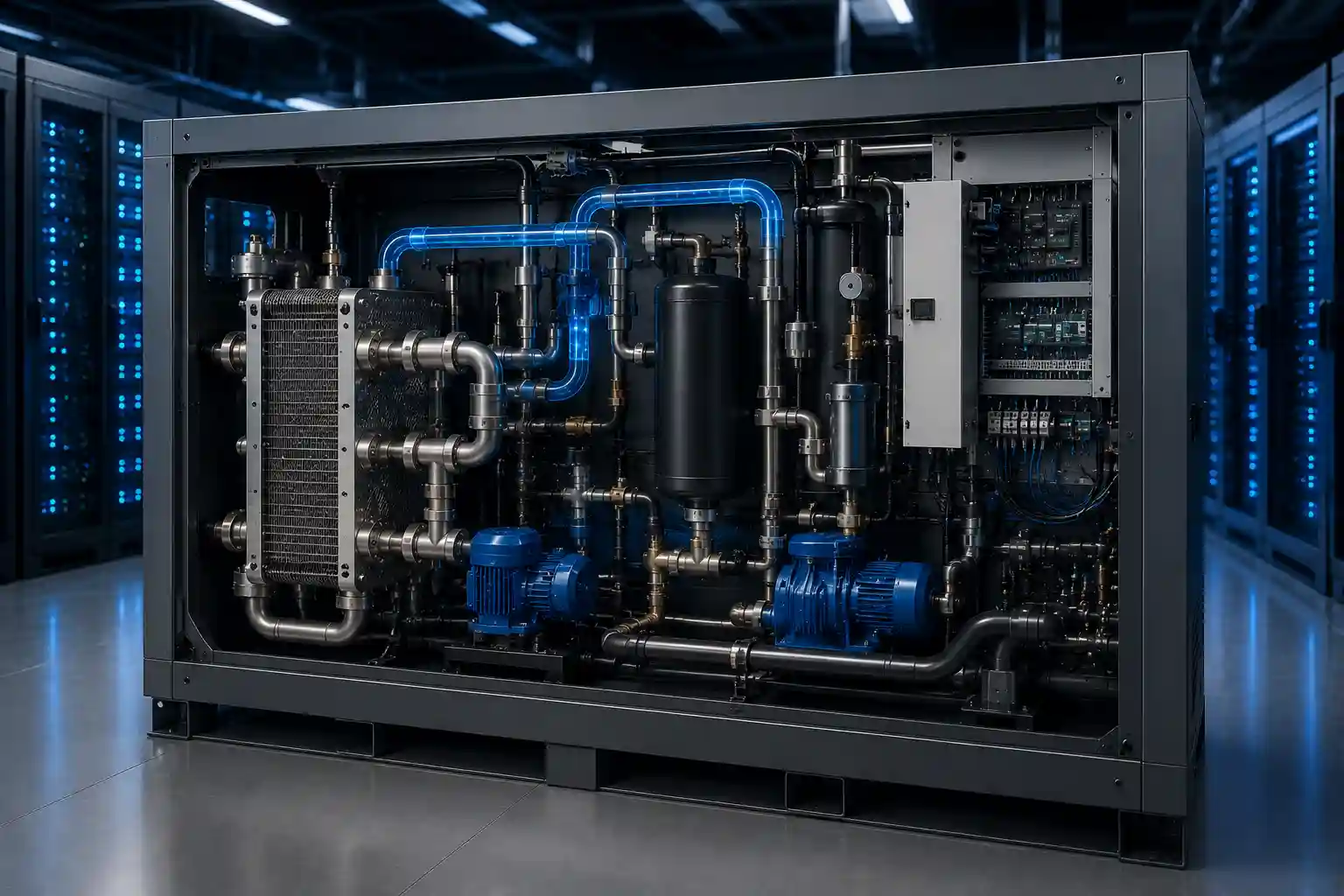
As liquid cooling becomes the preferred thermal management solution for AI data centers, high-performance computing (HPC), and next-generation server infrastructure, Coolant Distribution Units (CDUs) have emerged as a critical component within modern cooling architectures.
A CDU acts as the central control hub of a liquid cooling system. It regulates coolant flow, maintains temperature stability, transfers heat, and ensures reliable operation of cooling loops serving high-power IT equipment. Without a properly designed CDU, even the most advanced cold plates and liquid cooling technologies cannot achieve optimal performance. A CDU typically manages coolant flow, pressure, and temperature while serving as the interface between facility cooling infrastructure and IT equipment.
What Is the Function of a CDU?
The primary role of a CDU is to distribute coolant throughout a liquid cooling system while maintaining precise control over operating conditions. The CDU circulates coolant through cold plates or other cooling devices, removes absorbed heat, and continuously monitors system performance to ensure safe and efficient operation.
In modern AI data centers, CDUs often create an isolated secondary cooling loop between facility water systems and server cooling systems. This approach improves reliability, reduces contamination risks, and allows operators to maintain precise control of coolant temperature, pressure, and flow rates.
Core Components of a CDU System
A typical CDU contains several integrated subsystems that work together to deliver stable thermal performance.
1. Pumps
Pumps are responsible for circulating coolant throughout the cooling loop. They provide the pressure required to move coolant through cold plates, manifolds, piping, and heat exchangers.
Many enterprise-grade CDUs incorporate redundant pump configurations to ensure continuous operation in the event of a component failure. Variable-speed pumps may also be used to adjust coolant flow based on changing thermal loads and improve overall energy efficiency.
2. Heat Exchanger
The heat exchanger is often considered the heart of the CDU. Its function is to transfer heat from the secondary coolant loop to the facility cooling loop without allowing the two fluids to mix.
By isolating facility water from the IT cooling circuit, the heat exchanger helps prevent contamination, improves reliability, and enables independent control of each cooling loop. Plate heat exchangers are commonly used due to their compact size and high thermal efficiency.
3. Control Valves
Control valves regulate coolant flow and pressure throughout the system. These valves automatically adjust operating conditions based on real-time thermal requirements, helping maintain stable temperatures and balanced flow distribution across multiple cooling devices.
Advanced CDUs utilize motorized valves and intelligent control algorithms to optimize cooling performance under varying workloads.
4. Sensors and Monitoring Devices
Continuous monitoring is essential for maintaining reliable liquid cooling operation.
Modern CDUs typically incorporate:
- Temperature sensors
- Pressure sensors
- Flow meters
- Leak detection systems
- Coolant level monitoring
These devices provide real-time visibility into system conditions and enable operators to identify potential issues before they affect equipment performance.
5. Control System
The control system serves as the intelligence center of the CDU.
Using data collected from sensors, the controller automatically adjusts pump speeds, valve positions, coolant temperatures, and alarm settings. Many modern CDUs support remote monitoring and integration with Data Center Infrastructure Management (DCIM) platforms, allowing operators to manage cooling systems efficiently across multiple facilities.
6. Filtration System
Maintaining coolant cleanliness is essential for protecting cold plates and other precision cooling components.
Integrated filtration systems remove contaminants, particulates, and debris from the coolant stream, helping preserve cooling performance and extend equipment lifespan.
7. Expansion Tank and Reservoir
As coolant temperatures fluctuate, fluid volume changes naturally occur within the system.
Expansion tanks and reservoirs accommodate these volume variations, stabilize system pressure, and support safe operation under changing thermal conditions.
Why CDU Design Matters
As AI processors continue to increase in power density, cooling systems must deliver greater thermal performance while maintaining reliability and energy efficiency. A well-designed CDU enables precise temperature control, supports higher rack densities, reduces operational risks, and improves overall system efficiency.
Whether deployed in direct-to-chip cooling architectures, immersion cooling systems, or hybrid liquid cooling environments, the CDU remains a foundational component that ensures heat is removed safely and effectively from mission-critical computing infrastructure.
Conclusion
A CDU is far more than a simple coolant distribution device. It functions as the operational center of a liquid cooling system, integrating pumps, heat exchangers, valves, sensors, filtration, and intelligent controls into a unified platform.
By maintaining stable coolant flow, pressure, and temperature, CDUs enable the reliable operation of modern AI servers, high-performance computing systems, and next-generation data centers. As liquid cooling adoption continues to accelerate, CDU technology will play an increasingly important role in supporting future computing demands.